NVMe vs SSD VPS Hosting: Which Delivers Better Speed & Performance?
Comparison Updated on : January 2, 2026Speed and performance are no longer optional in web hosting. Whether you are running a business website, SaaS platform, eCommerce store, or high-traffic blog, your hosting infrastructure directly impacts user experience, SEO rankings, and conversion rates.
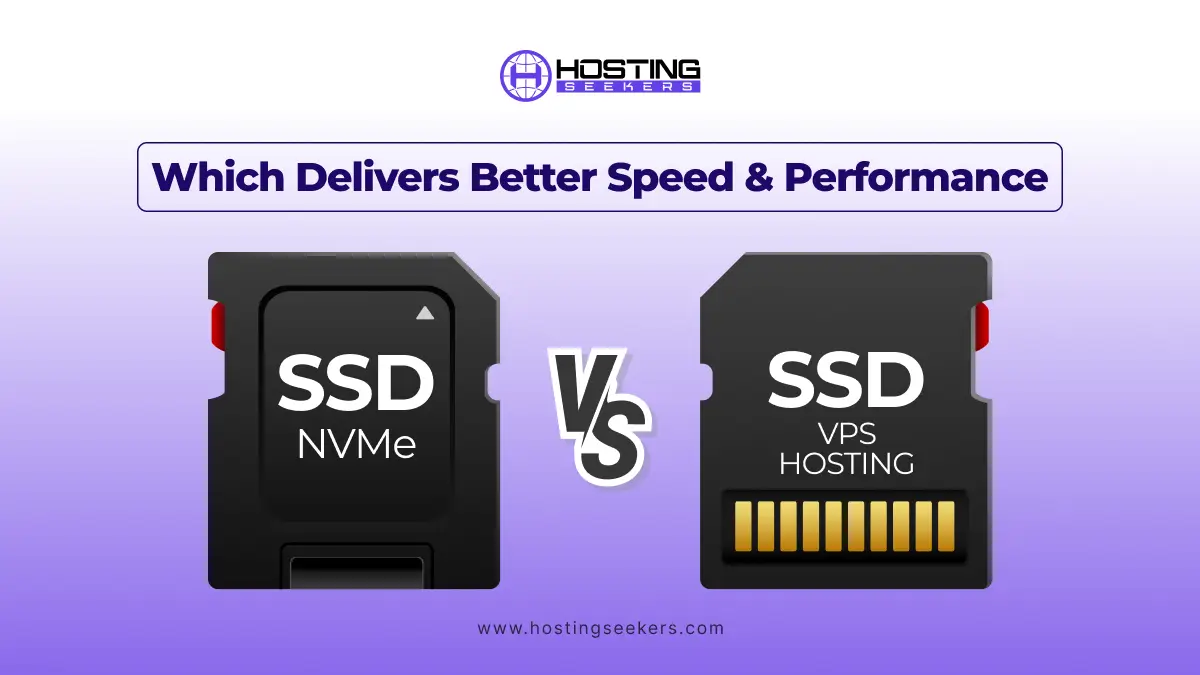
Among various VPS hosting options, NVMe VPS and SSD VPS hosting are the most compared solutions today. While both use solid-state storage, they differ significantly in technology, speed, latency, and real-world performance.
In this guide, we will break down NVMe vs SSD VPS hosting in detail, covering technology, performance benchmarks, use cases, cost considerations, and when upgrading truly makes sense.
What is NVMe technology?
NVMe (Non-Volatile Memory Express) is a modern storage protocol specifically engineered to unlock the full performance potential of high-speed flash storage, unlike traditional SSDs, which rely on the SATA interface, initially designed for mechanical hard drives. This difference between NVMe vs traditional SATA-based storage plays a major role in determining real-world performance for modern VPS hosting environments.
NVMe drives connect directly to the PCIe bus, enabling data to move between the storage device and the CPU with far greater efficiency.
This direct connection significantly reduces latency while enabling thousands of parallel command queues, making NVMe ideal for handling multiple simultaneous read and write operations.
As a result, NVMe technology delivers exceptionally high IOPS performance, faster data access, and smoother handling of demanding workloads such as databases, virtualization, and high-traffic websites.
With PCIe-based data transfer, NVMe drives can achieve speeds up to six to ten times faster than SATA SSDs, while also maintaining lower CPU overhead and superior performance in concurrent operations, making them a preferred choice for modern, performance-driven hosting environments.
Understanding NVMe VPS
NVMe VPS hosting is a high-performance virtual private server solution that leverages NVMe SSD storage at the hypervisor or server level to deliver dramatically faster disk speeds than traditional SSD-based VPS plans. By using NVMe drives connected directly via PCIe, NVMe VPS hosting minimizes storage latency.
It maximizes data throughput, enabling applications to access and process data with exceptional efficiency. This architecture allows virtual servers to fully leverage the parallel processing capabilities of NVMe technology, resulting in smoother, more consistent performance even under demanding workloads.
One of the most noticeable advantages of NVMe VPS hosting is ultra-fast website loading, which directly improves user experience and SEO performance.
Applications that depend on frequent database queries, such as content-heavy websites, SaaS platforms, and APIs, benefit from high IOPS and rapid read and write operations, resulting in faster query execution and reduced response times.
NVMe VPS hosting also performs exceptionally well during traffic spikes, maintaining stability and speed when multiple users access the server simultaneously. Routine operations such as backups, restores, and data migrations are completed much faster, reducing downtime and improving operational efficiency.
What is SSD Technology?
SSD (Solid State Drive) technology is a modern data storage solution that uses flash memory to store data instead of spinning magnetic disks found in traditional hard drives.
Because SSDs have no moving parts, they are significantly faster, more reliable, and more energy-efficient than HDDs. Data can be accessed almost instantly, reducing latency and improving overall system responsiveness.
SSDs commonly use interfaces such as SATA or, in some cases, SAS, both of which offer a significant performance upgrade over older storage technologies. Due to their speed and stability, SSDs have become the standard storage option for servers, personal computers, and hosting environments where consistent performance is essential.
Understanding SSD VPS
SSD VPS hosting is a virtual private server solution that uses SSD storage to deliver faster performance than HDD-based VPS plans. By replacing traditional hard drives with SSDs at the server level, SSD VPS hosting significantly improves boot times, file access speeds, and application responsiveness.
This makes it well-suited for websites, applications, and databases that require steady performance without the high cost of premium NVMe storage.
SSD VPS hosting offers a balanced combination of speed, reliability, and affordability, making it a popular choice for small to medium-sized websites, business applications, development environments, and workloads that benefit from faster disk access but do not demand extremely high IOPS.
NVMe vs SSD vs HDD: A Quick Storage Technology Comparison
1. HDD (Hard Disk Drive): Traditional Mechanical Storage
Hard Disk Drives are the oldest and most widely used storage technology. They store data on spinning magnetic platters and use mechanical read/write heads to access it. Because of their mechanical moving parts, HDDs have higher latency, slower data transfer speeds, and lower IOPS than modern storage solutions.
While they are not ideal for performance-intensive workloads, HDDs remain popular for backups, archives, and large-scale data storage due to their low cost per gigabyte and high storage capacities.
2. SSD (Solid State Drive): Faster and More Reliable Flash Storage
Solid State Drives marked a significant leap forward by eliminating mechanical components and adopting flash memory. This design drastically improves data access times, reduces latency, and enhances overall system responsiveness.
Most standard SSDs use the SATA interface, which makes them much faster and more reliable than HDDs for operating systems, websites, and business applications.
However, SATA-based SSDs are still constrained by the SATA interface’s bandwidth, which limits their performance.
3. NVMe (Non-Volatile Memory Express): High-Performance Storage Technology
NVMe is the most advanced of the three, explicitly designed to maximize the performance of flash-based storage. Instead of using SATA, NVMe operates over the PCIe bus, enabling dramatically higher throughput and ultra-low latency.
It supports thousands of parallel command queues, making it exceptionally efficient for handling multiple simultaneous read and write operations. NVMe storage is ideal for high-traffic websites, databases, cloud hosting, virtualization, and other performance-critical workloads where speed, scalability, and efficiency are essential.
Overall Comparison and Use Cases
In summary, HDDs are best suited for cost-effective, long-term storage and backups; SSDs offer a strong balance of speed, reliability, and affordability for general workloads; and NVMe drives deliver top-tier performance for modern applications that demand fast data access and high concurrency. Choosing the proper storage technology depends on performance requirements, budget, and the nature of the workload.
NVMe vs SSD: What’s the difference?
| Feature | SATA SSD | NVMe SSD |
|
Storage Type |
Flash memory |
Flash memory |
|
Interface |
SATA III |
PCIe (Gen 3/4/5) |
|
Protocol |
AHCI |
NVMe |
|
Maximum Speed |
Up to ~550 MB/s |
3,000–14,000+ MB/s (depending on PCIe generation) |
|
Latency |
Low |
Ultra-low |
|
Command Queues |
1 queue (up to 32 commands) |
Up to 64K queues (64K commands per queue) |
|
IOPS Performance |
Moderate |
Very high |
|
CPU Overhead |
Higher compared to NVMe |
Lower and more efficient |
|
Performance Under Load |
Can bottleneck with heavy workloads |
Handles high concurrency efficiently |
|
Best For |
OS, basic websites, small apps |
Databases, cloud hosting, high-traffic sites |
|
Cost |
More affordable |
Slightly higher |
|
Upgrade Impact |
Noticeable improvement over HDD |
Maximum performance boost |
NVMe VPS vs Standard SSD VPS: Is it Worth the Upgrade?
Choosing between NVMe VPS and standard SSD VPS hosting depends mainly on your performance needs and the type of workload your server will handle. Standard SSD VPS hosting already delivers a significant improvement over HDD-based servers, offering faster boot times, quicker file access, and better overall reliability.
For many small-to-medium websites, blogs, and basic business applications, SSD VPS offers a cost-effective balance between performance and affordability.
However, SSD VPSs can face limitations under heavy traffic or data-intensive operations due to the SATA interface’s bandwidth constraints. NVMe VPS hosting takes performance a step further by leveraging NVMe storage connected directly via the PCIe bus. This results in dramatically lower latency, faster read/write speeds, and superior IOPS performance.
If your application involves frequent database queries, real-time data processing, virtualization, or high-traffic workloads, the performance gains from NVMe VPS can be clearly noticeable. While NVMe VPS typically costs slightly more, the improvements in speed, responsiveness, and scalability often justify the upgrade for performance-driven use cases.
When to Choose NVMe vs SSD VPS hosting?
| Requirement | Choose NVMe VPS Hosting | Choose SSD VPS Hosting |
| Website Traffic Volume | High-traffic websites with frequent user activity and heavy requests. | Low to medium traffic websites. |
| Application Type | Data-intensive apps, SaaS platforms, cloud apps, and AI/ML workloads. | Blogs, corporate sites, and portfolio websites. |
| Database Usage | Large or frequently accessed databases with complex queries. | Small to medium databases with limited queries. |
| Performance Sensitivity | Applications where low latency and fast response time are critical. | Applications with standard performance needs. |
| Concurrent Operations | High concurrency with multiple simultaneous read/write tasks. | Limited concurrent operations |
| Virtualization & Containers | Ideal for virtualization, Docker, Kubernetes, and microservices. | Suitable for basic VPS usage and testing. |
| eCommerce & Transactions | Large eCommerce stores with real-time inventory and checkout. | Small online stores with limited daily transactions. |
| Development & Staging | Production environments require fast builds and deployments. | Development, staging, and testing environments. |
| Budget Consideration | Higher budget with focus on performance and scalability. | Budget-friendly option with reliable performance. |
| Scalability & Future Growth | Best for fast-growing projects and future-ready infrastructure. | Suitable for stable projects with predictable growth. |
| User Experience Impact | Faster page loads and smoother interactions under load. | Good user experience for moderate workloads. |
| Long-Term Value | Higher ROI for performance-driven businesses. | Cost-effective for basic and moderate use cases. |
NVMe vs SSD VPS: Final Verdict
In conclusion, upgrading to NVMe VPS is worth it if your application demands high performance, low latency, and the ability to handle intensive workloads efficiently. NVMe VPS offers clear advantages in speed and scalability, making it a future-ready choice for growing businesses and resource-heavy applications. However, if your requirements are modest and budget-conscious, standard SSD VPS remains a dependable and cost-effective hosting solution. The right choice ultimately depends on your performance expectations, traffic volume, and long-term growth plans. Explore verified and trusted NVMe VPS hosting providers for 2026 to get maximum performance for your workload.
Frequently Asked Questions
Q 1. Is NVMe VPS faster than SSD VPS?
Ans. Yes, NVMe VPS hosting is significantly faster than SSD VPS. NVMe storage communicates directly with the CPU via PCIe, resulting in lower latency, higher IOPS, and faster read/write speeds than traditional SSDs that rely on the SATA protocol.
Q 2. How much faster is NVMe compared to SSD VPS?
Ans. On average, NVMe VPS can be 4–6 times faster than SSD VPS for IOPS and data transfer speeds. Real-world improvements include faster boot times, quicker database queries, and reduced page load times.
Q 3. Does NVMe VPS improve website loading speed?
Ans. Yes. NVMe VPS reduces server response time and disk latency, thereby improving website loading speed, especially for dynamic websites, CMS platforms like WordPress, and database-driven applications.
Q 4. Is NVMe VPS hosting worth the extra cost?
Ans. NVMe VPS is worth the extra cost if your website or application requires high performance, handles heavy traffic, or runs complex workloads. For small or low-traffic websites, SSD VPS still provides excellent performance at a lower price.
Q 5. Which is better for WordPress: NVMe VPS or SSD VPS?
Ans. NVMe VPS is better for WordPress sites with high traffic, multiple plugins, or WooCommerce stores. SSD VPS works well for basic WordPress websites or blogs with moderate traffic.

manvinder Singh
https://www.hostingseekers.com
Manvinder Singh is the Founder and CEO of HostingSeekers, an award-winning go-to-directory for all things hosting. Our team conducts extensive research to filter the top solution providers, enabling visitors to effortlessly pick the one that perfectly suits their needs. We are one of the fastest growing web directories, with 500+ global companies currently listed on our platform.