Rewind 2025 Hosting World!
IT Updated on : September 17, 2026In 2025, the web hosting industry has changed a lot because of new technologies, changing business needs, and a greater focus on security and sustainability. As we look back on this important year, the hosting industry tells stories of huge market growth, new technologies that change the game, and changing priorities toward being more efficient and responsible to the environment.
This comprehensive article explores the defining trends, market developments, and technological innovations that shaped the hosting industry throughout 2025.
Global Hosting Market in 2025
The global web hosting market was valued at around USD 125-149 billion in 2025, with multiple reputable sources converging in this range. Fortune Business Insights puts 2025 revenue at USD 126.41 billion, whereas Hostinger noted USD 125.36 billion, each expecting fast expansion over the next decade.
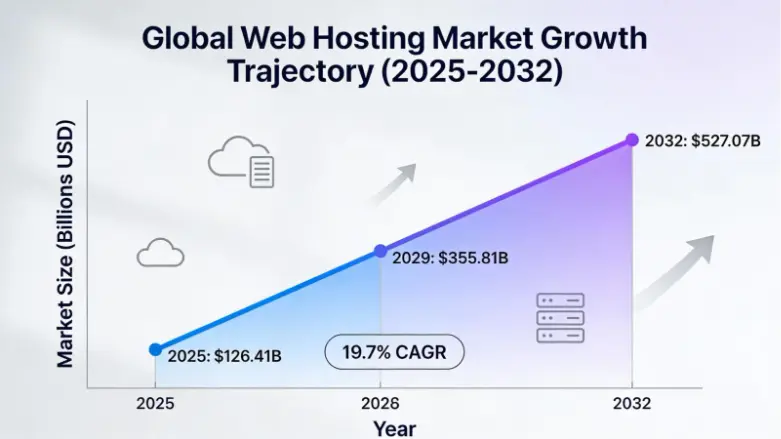
Predicted Growth Graph by Various Platforms
Fortune Business Insights expects the market to reach from USD 149.30 billion in 2025 to USD 527.07 billion by 2032, implying a long‑term CAGR of about 19.7%. What lies behind such growth? Numbers suggest steady momentum through the decade.
A jump from $125.36 billion in 2025 to $355.81 billion by 2029 stands out – driven by AI and cloud shaping how money flows into tech foundations. Growth at 23.6% yearly shows what’s gaining weight in budgets. Numbers like these don’t lie when it comes to where attention lands. (Source: Hostinger)
Dynamics of Regional Markets
With 39% of the worldwide web hosting market share in 2025, North America continues to hold its dominant position. The hosting industry in the United States alone brings in $44.75 billion, and by 2029, it is expected to reach $127.17 billion, a 23.5% CAGR.
Driven by initiatives for digital transformation and rising internet penetration, Europe and the Asia-Pacific trail closely behind. With a CAGR ranging from 13.7% to 18.28%, Asia-Pacific exhibits the fastest regional growth trajectory.
Despite being a smaller market segment, South America consistently grows year over year, especially in the Software-as-a-Service (SaaS) and e-commerce sectors.
Cloud, AI, and the New Infrastructure Reality
Adoption of Multi-Clouds Reaches Critical Mass
In 2025, hybrid and multi-cloud strategies have become the standard architectural approach in cloud computing. To balance performance, compliance, and cost considerations, 87% of businesses now use hybrid and multi-cloud configurations that combine private infrastructure with public cloud services.
Avoiding vendor lock-in, maximizing performance across geographies, and upholding compliance with local data protection laws are organizational priorities that are reflected in this broad adoption. Specifically, 89% of cloud-based providers use multi-cloud solutions in the web hosting industry.
For hosting buyers, this meant:
- Switching from fixed resource shared/dedicated servers to cloud instances that automatically scale in response to traffic volatility and artificial intelligence.
- Increasing reliance on managed and platform‑as‑a‑service offerings to offload infrastructure orchestration and security hardening.
The “Big Three” Dominance
Amazon Web Services (AWS), Microsoft Azure, and Google Cloud collectively control approximately 80% of the global cloud infrastructure market. AWS continues to lead the industry, powering 5.1% of all websites worldwide and holding a 31% market share.
This concentrated market share conceals a complex ecosystem where specialized providers like Cloudflare, DigitalOcean, Vultr, and regional leaders like OVH serve distinct customer segments with tailored solutions.
Key Drivers of Cloud Migration:
- Organizational change is accelerated by digital transformation initiatives.
- Growing use of AI and machine learning requires a strong infrastructure.
- Trends in remote work call for secure, easily accessible cloud solutions.
- Investment in managed security services is motivated by cybersecurity concerns.
By 2025, 80% of enterprises had already transitioned away from traditional on-premises data centers, completing migrations that began in the previous decade.
AI Integration: From Innovation to Necessity
AI became a core part of hosting operations rather than an optional feature. Hosting providers now rely on AI to monitor servers, predict failures, optimize resources, and detect security threats in real time.
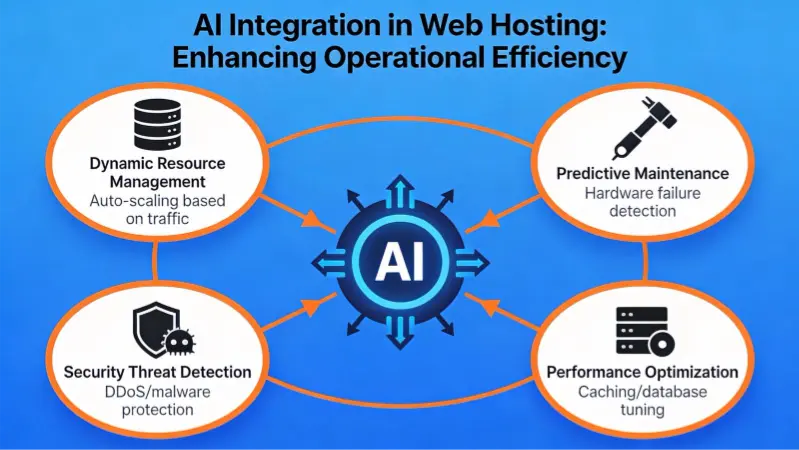
How does AI improve hosting infrastructure?
- Dynamic resource management: Automatically adjusts server resources based on traffic patterns to maintain performance during peak demand.
- Predictive maintenance: Uses machine learning to identify potential hardware failures early, reducing downtime and unnecessary costs.
- Security threat detection: Analyzes traffic behaviour to identify and stop threats like DDoS attacks, malware, and intrusion attempts.
- Performance optimization: Continuously fine-tunes caching, databases, and content delivery for faster application performance.
AI Workloads and Hosting Growth
AI workloads are now a primary hosting use case. As businesses deploy AI at scale, hosting platforms are evolving with GPU-dense infrastructure, multi-model AI support, and AI-ready environments. AI-optimized hosting is expected to remain a major growth driver for cloud and hosting providers through 2030.
Rise of AI in the Hosting World
In 2025, AI became the default layer for security, performance, and support. Providers use AI for automated scaling, threat detection, incident response, and uptime optimization. AI-powered analytics help prevent outages, while chatbots handle routine customer support tasks efficiently.
Looking ahead to 2026, hosting providers expect AI to further automate infrastructure management, improve uptime through predictive insights, and strengthen security with advanced AI-driven protection.
Hosting Customization Rises Well
In 2025, hosting wasn’t just “plans and prices” but increasingly meant tailored stacks for specific workloads and audiences. Industry commentary on future hosting trends highlights:
- Vertical‑specific hosting (e.g., optimized for WordPress, ecommerce, or SaaS) with tuned caching, security, and support.
- Configurations customized for AI workloads, including GPU options, dedicated networking, and higher‑throughput storage.
- Flexible control panels and APIs enabling customers to script deployment, integrate CI/CD, and manage infrastructure as code.
This shift was pointed to businesses “stopping viewing hosting as a commodity” and treating it as a strategic asset for performance and growth.
Security Becomes Non-Negotiable
Core security components:
| Security Feature | Function | Impact |
| SSL/TLS Encryption | Secures data transmission between servers and users | 88% of websites now use HTTPS as baseline |
| DDoS Protection | Prevents distributed denial-of-service attacks | Capacity up to 100+ Gbps handles largest attacks |
| Web Application Firewall (WAF) | Blocks application-layer attacks (SQL injection, XSS, CSRF) | Protects against most common attack vectors |
| Zero Trust Architecture | Assumes no user/device is trustworthy by default | Requires verification for every access request |
| AI-Driven Threat Detection | Machine learning identifies novel attack patterns | Responds to threats faster than human analysis |
| Automated Backup & Recovery | Ensures data resilience against ransomware | Implements geographic redundancy |
| Encryption at Rest & in Transit | Protects data in storage and during transmission | Renders stolen data unreadable to attackers |
Security went from a checkbox to a qualifying criterion in 2025 as cyber threats intensified. Reports on cybercrime and hosting trends underline several themes:
- Gartner and other security analysts have consistently framed cloud misconfigurations, ransomware, and web application exploits as primary enterprise risks, driving demand for hardened hosting environments and managed security layers.
- Hosting guides emphasize standardization around DDoS protection, web application firewalls (WAFs), malware scanning, and automated patching as baseline features, not upsells.
Zero‑trust hosting mindset
Zero-trust concepts increasingly permeate hosting architecture.
- Security best‑practice discussions show organizations shifting to identity‑centric models, where users, services, and devices are authenticated and authorized continuously instead of relying on trusted network perimeters.
- For hosting, this translates into least‑privilege access, strong identity and access management (IAM), segmentation, and continuous monitoring, especially as multi‑cloud and hybrid environments grow.
Compliance awareness
Regulatory and contractual expectations tightened, especially around data and uptime.
- IT services market research highlights compliance, data privacy, and uptime SLAs as central buying factors, particularly in finance, healthcare, and public sectors.
- Sustainability regulations and industry standards for data center efficiency also began influencing hosting procurement, tying environmental reporting to compliance conversations.
Proactive monitoring vs reactive support
The support model evolved from “ticket after downtime” to “detect before impact.”
- Hosting trend articles stress 24/7 proactive monitoring, anomaly detection, and predictive analytics as differentiators, reducing the number and duration of incidents that customers even notice.
- AI‑enhanced observability stacks help providers anticipate resource exhaustion, atypical traffic, or security anomalies, shifting support from reactive firefighting to preventive care.
Inclination towards Green Hosting
Environmental impact was no longer a side note in 2025 – it became a defining constraint and differentiator.
Why did sustainability suddenly matter more?
A combination of data center energy use, AI workloads, and regulation pushed green hosting into the spotlight.
HostPapa’s green hosting deep-dive cites estimates that the broader tech sector’s electricity use could reach around 20% of global consumption by 2025, up from roughly 7% earlier in the decade, based on Greenpeace projections. To make the most of their eco-friendly services, check out the latest HostPapa discount coupons for additional savings.
Market and demand signals
Several data points indicate that green hosting is transitioning from a niche market to a mainstream expectation. A report from CLDY show that 46.2% of web professionals are evaluating green hosting options. The green data center segment for SMEs is growing at a CAGR of approximately 20.15%, driven by demand for efficient infrastructure.
Energy and carbon‑aware operations
To manage AI-driven power demand, hosting providers are increasingly focused on efficiency rather than scale. Adoption of energy-efficient hardware, advanced cooling (including liquid cooling), and renewable energy integration as core strategies.
Practices such as carbon-aware workloads, routing, or scheduling compute based on grid carbon intensity, emerged in sustainability discussions, though measurable 2025 adoption data remain limited, making this an emerging pattern rather than a standard.
Customer preference shifts
Over 64% of consumers pay attention to brand sustainability, reinforcing green hosting as a factor in purchasing decisions. Educational resources increasingly encourage businesses to highlight sustainable hosting as part of brand trust and compliance, reflecting a shift toward customers asking how providers power and operate their infrastructure.
Certification surge & corporate commitments
Data from the .eco domain registry shows websites using .eco are supported by 154 green hosting providers, reflecting ~13% increase from the prior year and a more competitive sustainability landscape. Additionally, Hostinger has publicly stated a goal of achieving 100% renewable electricity by 2026, placing near-term renewable commitments on the industry agenda. Source: CLDY
Industry Leaders in Green Hosting:
- Hostinger: Powers data centers with renewable energy from solar and wind sources
- HostPapa: Among the first movers in green hosting, offsetting thousands of tonnes of CO2 through RECs
- DreamHost: Employs renewable energy, a remote-first workplace, and reduces commute emissions
- Kualo Hosting: Offset 2,204.74 tons CO2, planted 74,995 trees to date
Data Center Innovation
Hosting providers implemented innovative technologies, reducing environmental impact:
- Immersion Cooling: Significantly reduces energy consumption compared to traditional air-based cooling systems
- AI-Optimized Energy Usage: Machine learning adjusts data center operations for maximum efficiency
- Heat Reuse Applications: Excess server heat is captured and redistributed for residential heating, eliminating waste
Edge Computing
Why did latency matter more in 2025?
As streaming, gaming, video conferencing, SaaS, IoT, and AI-driven applications expanded, users increasingly expected real-time responsiveness rather than “fast enough” performance.
Hosting trend analyses consistently note that centralized cloud regions often introduced unacceptable round-trip delays for AI inference, industrial IoT, automation, and interactive workloads, especially where safety, reliability, or user experience were critical, pushing providers to move compute and content closer to end users.
Edge computing complements and does not replace the cloud
Rather than replacing the cloud, edge computing is emerging as a layer on top of cloud infrastructure. IDC estimates global edge spending at about USD 261 billion in 2025, projected to reach USD 380 billion by 2028 at a 13.8% CAGR, indicating strong enterprise investment in edge solutions.
Analyses emphasize that edge deployments are closely tied to public cloud and hybrid architectures, with workloads and data often orchestrated across cloud and edge, not shifted entirely away from hyperscalers.
Why does it matter for hosting?
For the hosting world, edge computing translates into:
- Distributed hosting architectures, where workloads are split across central clouds, regional data centers, and edge nodes.
- Lower latency and real‑time processing for global apps, gaming, streaming, and IoT, improving UX and enabling new use cases like live analytics and autonomous control.
- New product categories, from edge‑enhanced CDNs to specialized edge PaaS offerings, that hosting buyers must now evaluate alongside traditional shared/VPS/dedicated plans.
Low-Code and No-Code Platforms Democratizing Development
Low-code and no-code platforms will have fundamentally democratized application development by 2025. Seventy-five percent of new application development is expected to utilize low-code platforms by 2026, according to Gartner projections.
This shift enables developers without extensive coding expertise to build sophisticated applications, accelerating time-to-market and reducing development costs. Major platforms like Zapier, Retool, and bubble.io have matured significantly, while traditional cloud providers (AWS, Google Cloud, Azure) have expanded their low-code offerings.
AI-Powered Site Builders
AI-powered website builders have achieved significant market penetration in 2025, with 41% of businesses utilizing AI tools for website design and management. These platforms use generative AI to suggest layouts, optimize performance, and customize user experiences based on visitor behaviour and business objectives.
What does this mean for Hosting Buyers?
For hosting customers, all these shifts translated into very concrete changes in what “good hosting” looked like.
1. Faster deployments
- Containerization, managed Kubernetes, and platform‑as‑a‑service offerings made infrastructure deployment far quicker, especially when paired with CI/CD pipelines.
- AI‑assisted tools for configuration, documentation, and troubleshooting reduced time‑to‑launch for new sites and apps.
Actionable takeaway: choose providers that offer automated provisioning, templates for your stack (e.g., WordPress, headless CMS, or microservices), and CI/CD integration to cut launch time and human error.
2. Better uptime consistency
- Predictive analytics and AI‑driven monitoring tools enabled hosts to detect anomalies before they caused outages, improving uptime beyond basic SLA numbers.
- Edge and CDN layers decreased the impact of individual data center issues, spreading risk across multiple points of presence.
Actionable takeaway: look beyond “99.9% uptime on paper” and evaluate how providers monitor, how they architect redundancy, and whether they expose real‑time status and historical incident transparency.
3. Higher expectations from end customers
- As big platforms normalized fast, reliable experiences, users expected similar performance and security from smaller brands, regardless of their budget.
- Environmental and privacy expectations also rose, with more users caring about where and how data is hosted, not just if a site loads.
Actionable takeaway: treat hosting as a brand experience and trust layer; under‑investing in hosting translates directly into churn, cart abandonment, and reputational damage.
4. Pricing transparency became critical
- With complex stacks (compute + storage + network + security + edge), opaque pricing created unpleasant surprises, especially when AI workloads or traffic spiked.
- Cloud pricing comparisons and market reports stress the importance of clear unit pricing, bandwidth policies, and overage rules, particularly for SMEs with tight margins.
Actionable takeaway: prioritize providers that offer transparent, predictable pricing models, cost dashboards, and alerts; for AI or data‑intensive apps, run small pilots to understand real‑world costs before committing.
Top Events of the Hosting Industry in 2025
Industry events in 2025 reflected the same themes: open‑source ecosystems, cloud infrastructure, and AI‑driven innovation.
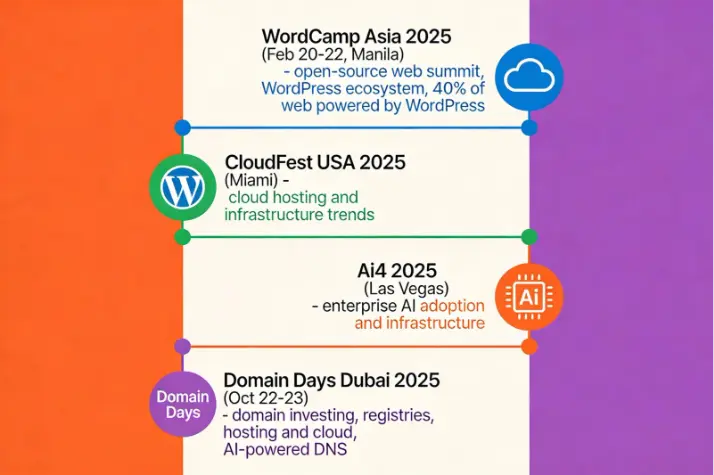
1. WordCamp Asia 2025
WordCamp Asia 2025 took place February 20 to 22, 2025, at the Philippine International Convention Center (PICC) in Manila, positioning itself as the premier open‑source web summit in Asia.
The event focused on the WordPress ecosystem (powering over 40% of the web), community contribution, and business opportunities around open‑source publishing and hosting.
2. CloudFest USA 2025 (Miami, Florida)
CloudFest USA 2025 is the North American edition of the long‑running CloudFest conference, dedicated to internet infrastructure, cloud hosting, and service provider innovation.
Hosted in the U.S. (2025 venues and specifics are published on CloudFest’s event site), it gathers hosts, registries, registrars, and SaaS vendors to discuss infrastructure trends, including AI, security, and green data centers.
3. Ai4 2025 (Las Vegas)
Ai4 2025 in Las Vegas is an enterprise AI conference, with tracks on AI adoption, infrastructure, and integration into business systems, including topics relevant to cloud and hosting platforms.
Content on AI for performance, security, and automation overlaps heavily with how hosting providers are expected to support AI‑heavy workloads in production.
4. Domain Days Dubai 2025 – October 22 – 23, 2025
Domain Days Dubai 2025 runs from October 22 to 23, 2025, at the Marriott Resort Palm Jumeirah, Dubai, as confirmed by ICANN and event organizers.
The event targets domain investors, registrars/registries, hosting and cloud providers, SaaS platforms, and security experts, with agendas covering domain fractionalization, AI‑powered DNS, new gTLD innovation, and broader hosting and infrastructure topics.
Coverage in regional media describes the 2025 edition as one of the most successful yet, with expanded attendance and deeper focus on digital infrastructure and AI‑related innovation.
Looking Ahead in 2026
The 2025 hosting world marked a clear turning point: hosting stopped being a background utility and became strategic infrastructure shaped by AI, edge, sustainability, and security expectations.
Buyers now evaluate providers not just on price and basic specs, but on how well they handle real‑time workloads, protect data, minimize environmental impact, and offer transparent, scalable platforms that can carry their business into 2026 and beyond.
For anyone choosing hosting today, the winning strategy is to treat infrastructure as a long‑term performance and trust investment, aligning with providers that are architected for AI, edge, green operations, and zero‑trust security from the ground up.
Frequently Asked Questions
Q1. What are the biggest trends in web hosting in 2025?
Ans. Major trends include AI integration in infrastructure and customer support, adoption of serverless and edge computing architectures, widespread hybrid and multi-cloud strategies, increasing emphasis on green hosting sustainability, and zero-trust security frameworks becoming standard.
Q2. How much does web hosting cost in 2025?
Ans. Shared hosting typically ranges from $3-$15 per month for beginners, VPS hosting from $10-$50 monthly, and dedicated hosting from $80-$500 or more, depending on specifications and performance requirements.
Q3. What is serverless hosting?
Ans. Serverless hosting allows developers to deploy code without managing the underlying infrastructure. Functions automatically scale based on demand, and users pay only for execution time, resulting in 70-80% cost savings for variable-traffic workloads compared to traditional hosting.
Q4. Why is green hosting important?
Ans. Green hosting reduces environmental impact by using renewable energy sources, implementing energy-efficient infrastructure, and purchasing carbon offsets. With approximately 46.2% of web professionals considering green hosting, it is a strategic competitive differentiator.

manvinder Singh
https://www.hostingseekers.com
Manvinder Singh is the Founder and CEO of HostingSeekers, an award-winning go-to-directory for all things hosting. Our team conducts extensive research to filter the top solution providers, enabling visitors to effortlessly pick the one that perfectly suits their needs. We are one of the fastest growing web directories, with 500+ global companies currently listed on our platform.