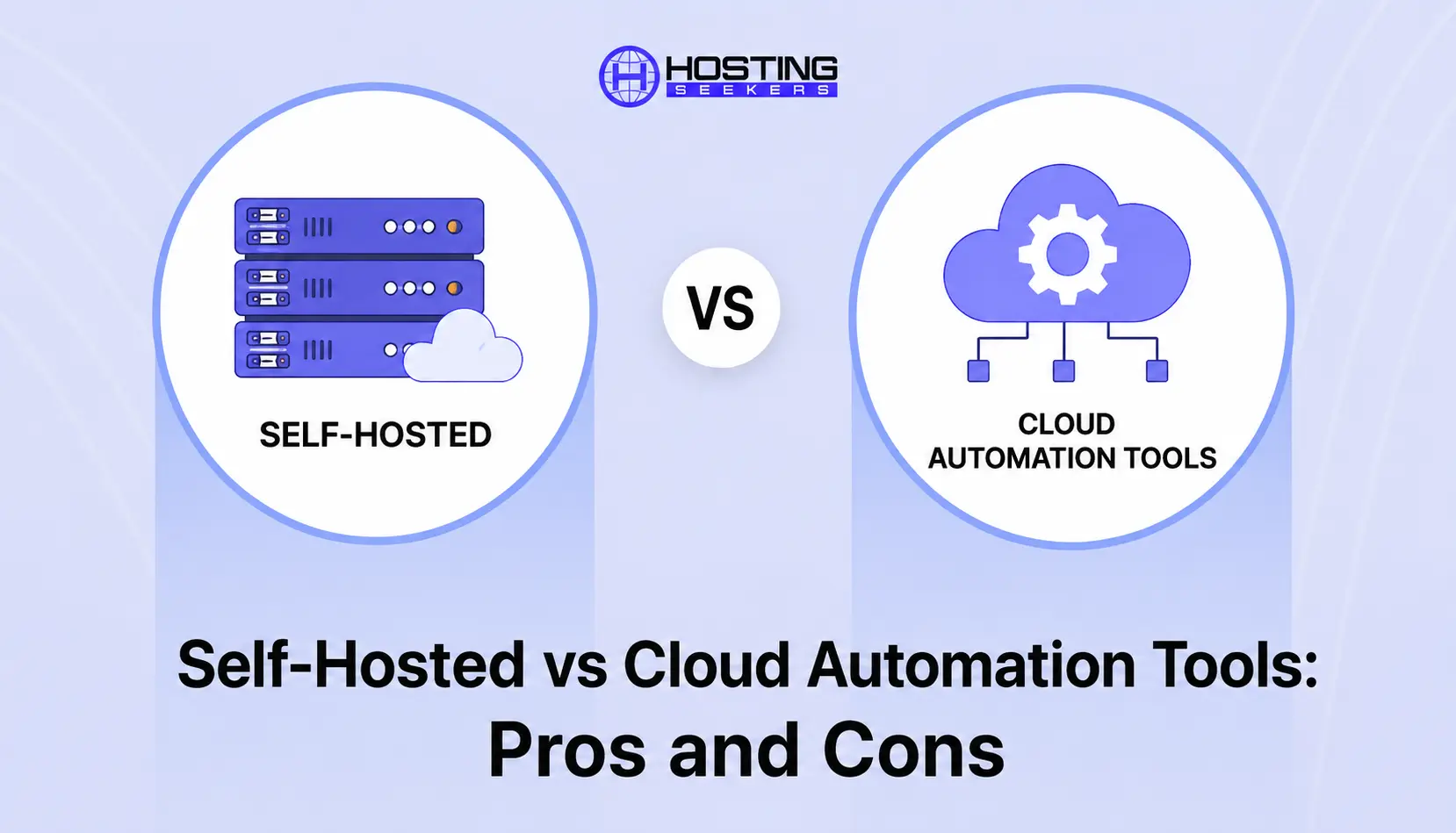
Self-Hosted vs Cloud Automation Tools: Pros and Cons
Web Hosting Tips Updated on : June 1, 2026Renting a flat when you relocate to a new city is a sensible decision. But when you settle down permanently, owning your home feels like the smarter choice. Both decisions are right. They just serve different needs at different times. Business works the same way. A business that wants full freedom, root access, security control, and privacy can go with self-hosted solutions like bare metal server hosting, managing everything on their own terms. A business that wants convenience can go with cloud automation tools like Zapier or Make, where the vendor handles everything, and you just log in and use it. Neither choice is wrong. It all depends on where your business stands today.
What is self-hosted?
Self-hosted means you download and run the software on an infrastructure that you completely control. You are in control of everything in your own environment, not on a vendor’s platform. It can be n8n hosted on your VPS or on a bare-metal server that you dedicate, where you have total control over the server, backups, security, OS, and configuration.
Pros
Full Control Over Data
Everything is in your environment. You control your software, workflows, files, databases, and security settings. This provides businesses with enhanced privacy, ownership of their internal data, and complete control over who has access to what. This is particularly important for businesses that handle sensitive customer or operational data with no third parties involved.
Lower Long-Term Cost
When you run n8n on your own KVM-based VPS or bare metal server hosting, you pay for your server, storage, and bandwidth, and that is it. There are no per-task fees or subscriptions that increase with your usage. Over time, this option becomes significantly more cost-effective than paying monthly for multiple cloud tools.
Customisation
With root access, you can configure your servers and software however your business needs them to be. Change server settings, adjust your environment setup, install what you want, and remove what you don’t. Everything bends to your requirement, not the other way around.
Minimal Vendor Dependence
Your system is completely yours to use, which means you’re free from the constraints imposed by external vendors. You won’t face any unexpected spikes in costs, limits on functionality, or other similar issues that may affect your business processes.
Scalability
You can scale up your infrastructure as per your growing demands. Upgrade your processor, add storage, add bandwidth—all without the worry of vendor policies and rates.
Cons
Technical Setup Required
Managing your infrastructure means you need working knowledge of servers, operating systems, databases, and security. Without that, the setup itself can become a challenge.
Maintenance Responsibility
Updates, patches, backups, monitoring, troubleshooting – all of it falls on you. There is no support team fixing things quietly in the background.
Security Responsibility
Running your own infrastructure means owning your security completely. You are responsible for configuring and maintaining access control, data protection, and firewall rules.
Not Ideal for Beginners
For a business in its early stages, managing self-hosted infrastructure can pull focus away from what actually matters, which is growing the business. Before taking on the technical responsibility, it helps to have at least a basic understanding of how servers work.
Cloud Automation Definition
While self-hosted software requires the user to install and manage the system themselves, cloud automation software has all of that done by the service provider itself. The user just needs to subscribe, create their workflows, and leave everything else on the provider’s side – server management, updates, and security. It’s simple to use, reliable, and perfect for beginners.
Pros
Simple to Install
The vendor does all the technology work, so you just sign up, log in, and start building your workflows. No installation, no server setup, no technical expertise needed. It is made as easy as possible for a first-time business owner or a non-technical person.
Lack of Supporting Infrastructure
The provider manages hosting, updates, backups, monitoring, and security on your behalf. This allows you to focus entirely on creating workflows and growing your business without worrying about infrastructure management.
Reliable Infrastructure
Cloud providers generally have high uptime; they can scale to your workload, and they monitor performance 24/7. That dramatically reduces the likelihood of downtime without you having to move a muscle.
Availability of Support
Most cloud automation vendors offer 24/7 customer support, platform assistance, and troubleshooting. When something breaks, it’s their team fixing it, not yours.
Beginner-Friendly
For a startup focused entirely on early growth, cloud automation removes every technical barrier. You concentrate on the business, and the provider concentrates on keeping everything running.
Cons
Less Data Control
Your data is stored on the provider’s infrastructure. Customer data, internal operations, compliance workflows – none of it is in your direct ownership. Such scenarios can be a real worry for businesses that handle sensitive information.
Vendor Dependency
You are subject to the provider’s uptime, pricing decisions, and feature updates. A sudden price hike, a service outage, or a discontinued feature can directly impact your business operations overnight. You need to go with a provider you trust.
Lack of Customisation
You generally cannot change server settings, set up your environment or tweak security settings beyond what they provide with cloud platforms. You play by their rules, not your rules.
Migration Data Issues
It’s rarely simple to move away from a cloud platform. If their pricing changes, or you need features that the platform no longer supports, migrating your workflows and data to another platform can cause compatibility issues or require rebuilding everything from scratch.
Which One Is Right for Your Business?
Cloud automation will be the easier entry point for small businesses just starting out. Less set-up, less stress, and more growth focus. But if your business is growing and you want full control over your data, costs, and workflows without the need to rely on a vendor, self-hosted solutions like bare metal server hosting or n8n hosting on your own VPS are more sensible in the long run.
The right choice is not about which tool is better. It is about where your business is today and where it is heading tomorrow.
Conclusion
Remember the analogy we started with. Renting makes sense when you are new to a city. Owning makes sense when you have settled in and know exactly what you need. Business automation works the same way.
If you are in the early stages and want to move fast and not worry about infrastructure, cloud automation tools will get you there quickly. If you are technically able and want the complete ownership of your data, security, and workflows, then self-hosting solutions such as Linux dedicated server hosting or n8n hosting on your server provide you with that control. There is not one correct answer. The right answer is the one that fits where your company is today.

manvinder Singh
https://www.hostingseekers.com
Manvinder Singh is the Founder and CEO of HostingSeekers, an award-winning go-to-directory for all things hosting. Our team conducts extensive research to filter the top solution providers, enabling visitors to effortlessly pick the one that perfectly suits their needs. We are one of the fastest growing web directories, with 500+ global companies currently listed on our platform.