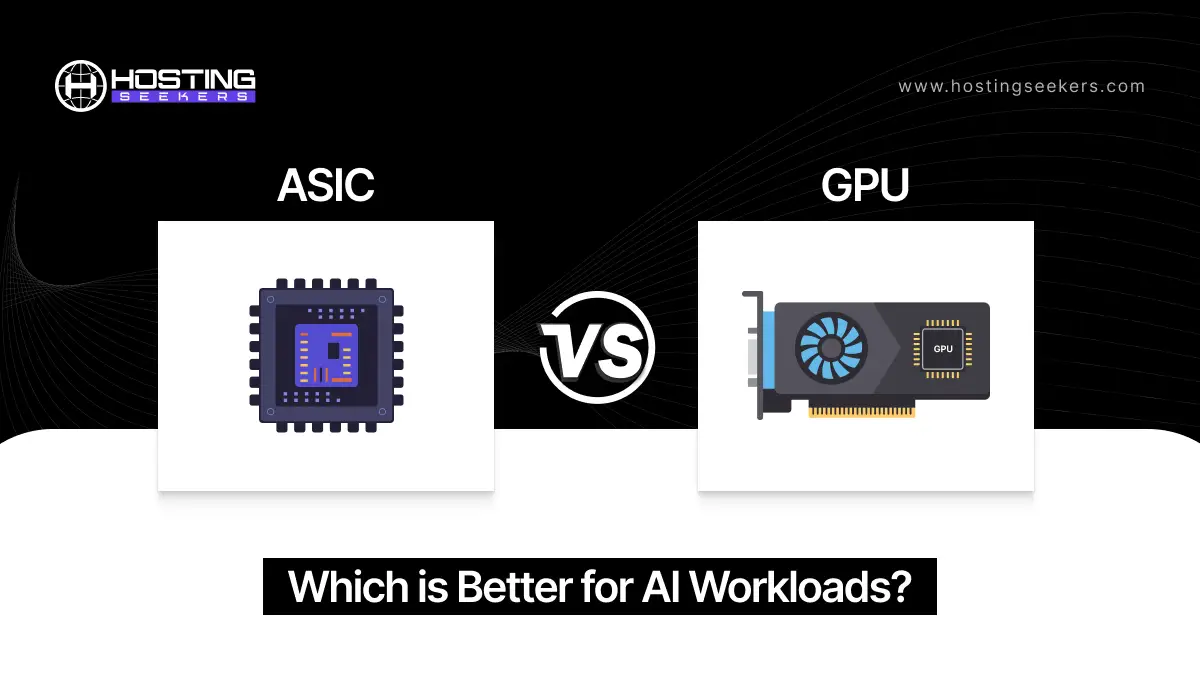
ASIC vs GPU: Which is Better for AI Workloads?
IT Published on : July 21, 2026Key Takeaways
- GPUs should be preferred for AI training, research, and flexible AI workloads.
- ASICs provide the highest performance and efficiency for dedicated AI inference workloads.
- GPUs have a mature ecosystem, enabling easy development and deployment using mainstream AI frameworks.
- ASICs require high initial development costs but become highly cost-effective when deployed at a large scale.
Artificial intelligence workloads demand immense computing resources, and the hardware selected may greatly affect its performance, price, and efficiency. When you are deploying AI models on AI servers, GPU servers, or enterprise infrastructure, choosing the right accelerator is essential for achieving the best results.
There are many AI accelerators that are currently in use. However, the two main types include GPUs (Graphics Processing Unit) and ASICs (Application-Specific Integrated Circuit). While GPUs provide versatility in dealing with various AI tasks, the latter is built especially for high performance and efficiency in particular tasks.
In this article, we are going to compare these two AI accelerators based on their performance, power consumption, cost, flexibility, and application to see which one suits you better for your AI project
ASIC vs GPU: The Head-to-Head Comparison
Before we go deep into each one, here’s the side-by-side view that most people are actually looking for:
| Factor | GPU | ASIC |
|---|---|---|
| Core design philosophy | General-purpose accelerator, adapted from graphics rendering. | Purpose-built for one specific workload from the ground up. |
| Flexibility | Runs almost any AI workload, including training, inference, computer vision, and more. | Excels at the exact task it was designed for but is a poor fit for anything else. |
| Best suited for | Training, research and development, and workloads that frequently change. | Large-scale, stable, high-volume inference. |
| Power efficiency | Lower performance-per-watt due to general-purpose overhead. | Can be dramatically more efficient; an inference ASIC can outperform a 300W GPU while consuming around 10W. |
| Upfront cost | Higher per-chip price (approximately $20,000 per GPU) but no custom design cost. | Lower per-chip price (approximately $5,000 per chip) but requires massive non-recurring engineering costs before deployment. |
| Software ecosystem | Mature and dominant, with CUDA and native support for PyTorch, TensorFlow, and JAX. | Narrow ecosystem, often locked to a single company’s internal software stack. |
| Time to obsolescence | Long useful life across many AI workload types. | Can become obsolete quickly if the underlying algorithm changes significantly. |
| Who typically uses it | Startups, research labs, cloud providers, and most companies running AI workloads. | Hyperscalers with the scale and budget to justify custom silicon. |
| Current market share (2028 forecast) | 75% of the AI accelerator market. | 25% of the AI accelerator market. |
GPU (Graphics Processing Unit)
A chip built around thousands of small cores that can all crunch numbers at the same time. It was originally made to render pixels for graphics, but that same “do the same math thousands of times at once” design turned out to be perfect for AI. Think of it as a general-purpose calculator that happens to be exceptionally good at AI. GPUs are the preferred accelerator for AI training and many inference workloads, making them the standard hardware found in modern GPU servers used by cloud providers and enterprises.
GPU Features
A GPU’s architecture is built around thousands of parallel cores paired with high-bandwidth memory (HBM), all backed by a mature software layer, CUDA, that lets developers program the same chip for different tasks. This programmability is what lets a GPU move from training a model one day to running inference or scientific computing the next, without swapping hardware.
- Parallel Processing Performance: GPUs are equipped with thousands of processing cores that can execute many calculations simultaneously. This massively parallel architecture enables them to accelerate compute-intensive workloads such as AI model training, deep learning, scientific simulations, and 3D rendering.
- Excellent Price-to-Performance Ratio: For workloads that benefit from parallel computing, GPUs deliver exceptional performance per dollar. They provide significantly more computational throughput than CPUs for tasks like machine learning, video processing, and data analytics, making them a cost-effective solution.
- Superior Energy Efficiency: By processing large numbers of operations in parallel, GPUs perform more computations per watt than traditional CPUs for suitable workloads. This improved energy efficiency helps reduce operating costs in AI data centers and high-performance computing environments.
- Seamless Scalability: GPU-based systems can easily scale to meet increasing computational demands. Organizations can add multiple GPUs within a single server or across clusters to accelerate larger AI models, faster training times, and high-volume inference workloads.
- AI-Optimized Hardware Architecture: Modern GPUs include specialized hardware such as Tensor Cores, Ray Tracing (RT) Cores, and high-bandwidth memory (HBM) to accelerate AI, deep learning, and scientific computing. Combined with mature software platforms like CUDA, ROCm, and popular AI frameworks, these architectural enhancements maximize performance across a wide range of AI applications.
Pros and Cons
| Pros | Cons |
|---|---|
| Highly programmable; the same chip can handle training, inference, and other AI workloads. | Higher power consumption than a task-specific ASIC performing the same job. |
| Backed by a massive and mature software ecosystem, including CUDA, PyTorch, TensorFlow, and JAX. | Higher per-chip price than an ASIC at equivalent production volume. |
| Longer useful lifespan because it is not limited to a single fixed task. | Includes general-purpose overhead, dedicating silicon to flexibility rather than maximum efficiency for one task. |
| No upfront chip-design cost and readily available through hardware vendors or cloud providers. | Less efficient than an ASIC for narrow, repetitive workloads at large scale. |
ASIC (Application-Specific Integrated Circuit)
A chip designed and manufactured for one particular job, with its logic built directly into the hardware rather than left flexible through software. Because an ASIC’s circuitry is dedicated entirely to one type of calculation, it can be far faster and far more power-efficient at that one task, but it can’t be reprogrammed to do something else once it’s made. ASICs are commonly deployed in large-scale data centers and specialized dedicated servers where organizations need maximum performance and power efficiency for a single AI workload.
ASIC Features
-
- Extreme Computing Performance: Chips for application-specific integrated circuits are made with particular tasks in mind and therefore possess incredible computational capabilities that cannot be matched by general-purpose processors. An example of such performance could be the latest Bitmain Antminer S21 XP Hydro, which provides a hash rate of 473 TH/s using only 5,676W and has an efficiency of 12 J/TH. It is not easy for a CPU or GPU to achieve such efficiency levels in the given task.
- Superior Power Efficiency: The first and foremost advantage of ASIC chips is energy efficiency. Due to the fact that ASIC chips do not include unnecessary elements of circuitry and optimize hardware to perform a certain task, they manage to save on power consumption by 70%. With regard to AI inference, Google TPU v5 makes unit computations 70% cheaper than conventional GPUs. Moreover, Amazon Trainium 3 utilizes just one-third of the power needed by equivalent GPU solutions.
- Lower Cost Over Time: While developing an ASIC entails a considerable initial cost, for instance, the design cost of a 7nm ASIC could be about $50 million, the manufacturing cost per chip becomes exceedingly low as more chips are produced. In one case, Google TPU v4 became extremely economical, reducing the unit cost from $3,800 to $1,200 as the production quantity rose from 100,000 to 1 million units. There was a 70% reduction in the unit cost.
- Smaller Size and More Space Efficient: Since an ASIC has been developed to perform specific computing tasks, it becomes possible to pack significantly more computing capability in a relatively smaller silicon chip.
Pros and Cons
| Pros | Cons |
|---|---|
| Dramatically better performance-per-watt for its target task and can outperform a much higher-wattage GPU. | Essentially zero flexibility; it cannot be reprogrammed for a new task after manufacturing. |
| Lower marginal cost per chip once production reaches large-scale volumes. | Requires very high non-recurring engineering (NRE) costs before the first chip is produced. |
| Smaller die footprint for the same effective computing power, making it ideal for space- and power-constrained devices. | Can become obsolete if the underlying algorithm or workload changes significantly. |
| Extremely low power consumption relative to its output after optimization for a specific task. | Only becomes financially viable at large, stable production volumes. |
Real-World Examples: Who’s Actually Using What
This debate isn’t hypothetical; it’s playing out right now across every major tech company. Here’s a quick look at the chips actually running in production.
GPU Examples
- NVIDIA A100 and H100: The workhorses of the current AI boom, offering strong integration with AI frameworks through CUDA and remaining the default choice for most AI workloads.
- NVIDIA Blackwell series: NVIDIA’s newer generation, rolling out across 2025–2026, pushing performance further for both training and inference.
- AMD Instinct MI200 / MI300 / MI350 series: AMD’s answer to NVIDIA, focused on high memory capacity and better tokens-per-dollar for generative AI, positioned as a cost-effective alternative.
ASIC Examples
- Google TPU (Tensor Processing Unit): The original AI ASIC, now on its seventh generation (Ironwood), reportedly used to train all phases of Gemini 3 without any NVIDIA GPUs involved.
- AWS Trainium and Inferentia: Amazon’s in-house chips, with Trainium built for training and Inferentia optimized specifically for inference, both aimed at lowering AWS compute costs.
- Microsoft Maia / Athena: Microsoft’s custom accelerators for Azure and Copilot, designed to reduce dependency on third-party GPUs while staying competitive on performance.
- Meta MTIA (Meta Training and Inference Accelerator): Used mainly to accelerate recommendation systems and some generative AI workloads as part of Meta’s long-term cost-control strategy.
- Intel Habana Gaudi2 / Gaudi3: Positioned as a cheaper, “good enough” alternative to NVIDIA GPUs for data center AI workloads.
When Should You Avoid GPUs?
You should avoid buying or relying on a dedicated GPU if:
- You are on a very limited budget and cannot justify the additional hardware cost.
- Your workload is primarily CPU-based, such as web browsing, office applications, email, or basic productivity tasks.
- You are building a compact or battery-powered system, such as an ultrabook or mini-PC, where power efficiency and longer battery life are more important than graphics performance.
- You don’t run GPU-intensive applications, such as AI training, 3D rendering, gaming, or video editing.
When Should You Avoid ASICs?
You should avoid using ASICs if:
- You have high electricity costs, as power expenses can quickly outweigh the performance benefits.
- Your AI workloads change frequently, since ASICs are designed for a single, fixed task and cannot be easily reprogrammed.
- You don’t have adequate cooling or ventilation, because high-performance ASICs can generate significant heat under continuous operation.
- You need flexibility for multiple applications, such as AI training, inference, and general computing, where GPUs are a better fit.
- Your deployment is small-scale, as the high upfront development and deployment costs of ASICs are only justified for large, stable workloads.
Conclusion
There is never a definite winner between ASICs and GPUs since the two components serve different purposes. GPUs still top the chart when it comes to AI model training, AI testing and experimentation, and companies that require versatility with different loads of data processing. The reason behind this is that GPUs have software versatility and are adaptive to AI changes.
ASICs are built specifically to give high performance and energy efficiency for their task. They are best suited for companies that process large amounts of stable AI inference workloads. This way, companies can save on operating costs.
Frequently Asked Questions (FAQs)
Q1. What is the difference between ASIC and GPU?
Ans. The GPU is a universal processor that can process multiple tasks in AI, and the ASIC is a device that is optimized for a certain task, providing high performance at the expense of low flexibility.
Q2. What is better for training?
Ans. It is better to use the GPU since it can process a wide variety of machine learning algorithms.
Q3. Is ASIC faster than GPU?
Ans. For the task it is intended for, the ASIC is faster and consumes less energy compared to the GPU. But it is not flexible enough for different workloads.
Q4. Why do companies still use GPUs when there are ASICs that are more efficient?
Ans. The GPU is a highly programmable device; it is popular and can use CUDA, PyTorch, and TensorFlow software environments.
Q5. Who needs an ASIC instead of a GPU?
Ans. An ASIC should be used by large companies or by cloud services for processing high-volume, stable inference workloads in AI.

manvinder Singh
https://www.hostingseekers.com
Manvinder Singh is the Founder and CEO of HostingSeekers, an award-winning go-to-directory for all things hosting. Our team conducts extensive research to filter the top solution providers, enabling visitors to effortlessly pick the one that perfectly suits their needs. We are one of the fastest growing web directories, with 500+ global companies currently listed on our platform.