How Website Performance, SEO and AI Search Work Together to Drive Business Growth?
IT Updated on : September 15, 2026You built a page that ranks number one, and traffic still went sideways. That story is more common than ever. Rankings are no longer the finish line, and the data behind that shift is hard to ignore.
In this guide, we will explain how website performance, SEO, and AI search work together to drive business growth, not as three separate checklists, but as one connected system. You will see where each layer fits, how they feed each other, and what that means for your leads, cost per acquisition, and revenue.
Every technical point resolves into a business outcome, and every claim stays grounded in what the data shows.
Why “We Rank #1” No Longer Means Growth
The search results page you optimized for is changing shape. A top spot still matters, but it no longer guarantees the click.
1. The click gap is real
AI Overviews have moved from a fringe feature to a fixture. Reported data shows them on roughly 13% of searches in early 2025, climbing to around 25% later in the year, and higher in some categories. When an AI Overview appears, organic click-through rate takes a hit. Seer Interactive’s study of 25 million impressions reported a 61% drop in organic CTR on those queries. Treat it as directional, but the direction is clear.
2. Rankings and AI visibility are separating
Here is the part most teams miss. Only about 38% of AI Overview citations now come from top-10 organic results, down from 76%. Ranking well no longer promises AI engines will quote you. So “good SEO” now has to mean more: visibility across both search results and AI answers, plus a site that turns that visibility into revenue.
The Three Pillars Are One System, Not Three Checklists
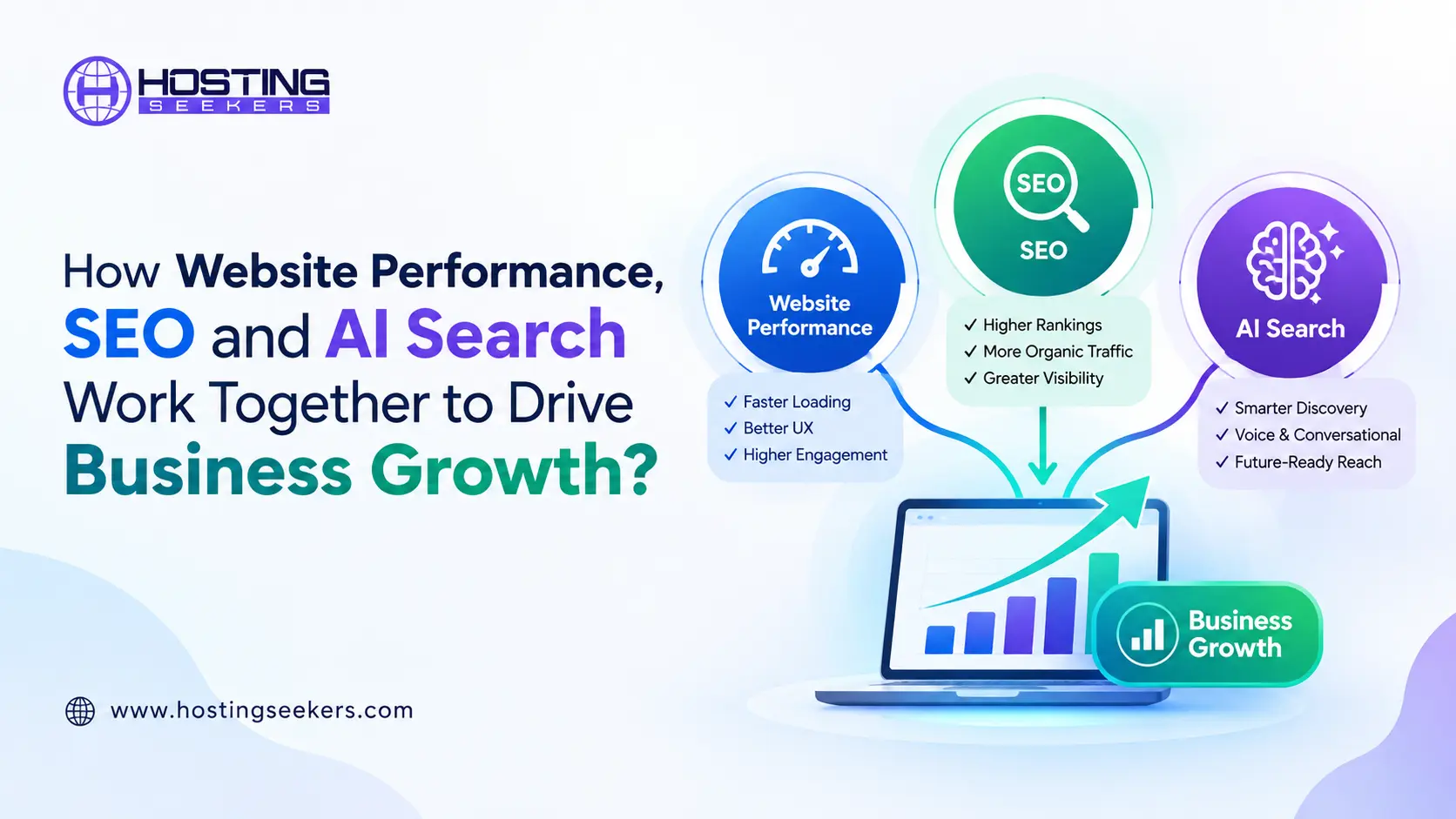
Think of performance, SEO, and AI search as a flywheel, not a to-do list. Each one makes the next work harder.
1. Performance is the foundation
A fast, stable site makes everything else possible. Slow pages lose users, lose conversions, and now lose visibility with AI crawlers. Nothing downstream compounds if the foundation leaks.
2. SEO earns rankings and authority
Genuinely relevant, useful content earns rankings. Technical and on-page signals give you the edge over equally strong competitors. That authority is the currency both Google and AI engines spend when they decide who to surface.
3. AI search converts authority into pre-qualified visitors
When an AI engine trusts your content enough to cite it, the visitor who clicks has often already done their early research. They arrive closer to a decision. That is the payoff at the end of the chain.
Bringing these layers together requires more than optimizing individual channels in isolation. An AI marketing agency, for example, can connect technical performance, organic search, content, and AI visibility into a single growth strategy—so improvements in one area support the others rather than competing for budget and attention
Pillar 1: Website Performance Drives Conversions and Now AI Visibility
Speed has always paid for itself in conversions. The new twist is that it now decides whether AI engines can even read you.
1. Faster sites convert better
Google reports that improving load times by just 0.1 seconds can lift retail conversion rates by around 8% and travel by around 10%. Sites meeting recommended Core Web Vitals see a reported 24% lower abandonment rate. A common benchmark: a one-second delay can cut conversions by about 7%.
Named examples get repeated across vendor reports, so hold them as illustrative. Vodafone reportedly improved Largest Contentful Paint by 31% and saw an 8% sales increase. Renault cut LCP by one second, dropped bounce rate 14%, and lifted conversions 13%. Pinterest reduced perceived wait time by 40% and reported a 15% rise in both SEO traffic and sign-ups.
2. Performance is a foundation, not a ranking silver bullet
Core Web Vitals are part of Google’s page experience signals, not the strongest ranking factor. Content quality and relevance come first. Performance gives you the tiebreaker over competitors who are just as relevant. Keep that order straight, and you avoid chasing perfect scores at the expense of better content.
3. Slow sites can go invisible to AI crawlers
AI crawlers work with finite processing budgets. If your site responds slowly or carries oversized files, the crawler may time out or ingest only part of your content. Fast responses matter to AI bots even more than to a traditional crawler, and time to first byte may weigh more heavily for AI answer visibility.
Two hidden traps are worth checking. If your content relies on client-side JavaScript with no server-side rendering, it can be invisible to crawlers like GPTBot and ClaudeBot. Cloudflare changed its defaults in 2025 to block AI bots automatically, so a site that never reviewed its bot rules may be quietly locking every AI crawler out. This is where technical SEO stops being housekeeping and starts protecting future pipeline.
Pillar 2: SEO Builds the Authority AI Engines Trust
Generative engines are not inventing a new rulebook. They lean on many of the same authority and relevance signals classic search already rewards.
1. The same signals power both search and AI
GEO and AEO, optimizing for generative and answer engines, enhance your SEO rather than replace it. Strong content, credible links, and clear relevance help you rank and help AI engines decide you are worth quoting. Split them into competing budgets, and you weaken both.
2. Structure content so AI can quote you
AI tends to extract the first clear answer it finds. Opening a page with a direct 40 to 60 word answer before your introduction is one of the highest-impact changes you can make. Keep structure clean, headings descriptive, and paragraphs scannable. You are making it easy for both a reader and a machine to find the point.
3. Hype versus fact on schema
Some sources claim schema markup gives content a much higher chance of appearing in AI answers. Structured data does help engines understand your pages. But Google states plainly that no special schema is required for AI Overviews or AI Mode. A page still has to be indexed and eligible for a normal snippet, and your structured data must match what is visible on the page. As for llms.txt, treat it as experimental, not a must-do. Sorting hype from fact is part of white-hat work, and it keeps your budget on things that move results.
Pillar 3: AI Search Delivers Fewer Clicks, But Better Clicks
The zero-click headlines read like a crisis. For businesses with strong foundations, they read more like an opening.
1. The zero-click reframe
Zero-click searches hit record levels in 2025, with a reported 58.5% of US searches ending without a click, and an average around 83% when AI Overviews appeared. That looks alarming until you notice which clicks are disappearing. Many are low-intent lookups that were never going to convert. The engine is filtering them out before they reach you.
2. AI visitors arrive pre-qualified
Because the AI handled the early research in the chat window, the person who clicks through is often further along. Studies agree on direction while disagreeing on magnitude. Semrush data suggests AI visitors convert at roughly 4.4x standard organic. Visibility Labs, studying 94 ecommerce brands, found ChatGPT traffic converting at 1.81% versus 1.39% for non-branded organic, about 31% higher. One study claims 23x, an outlier, so anchor on the conservative to mid-range. Volume is growing fast too: AI referrals reportedly jumped 357% year over year in mid-2025.
Fewer visitors, higher intent, stronger conversion. That combination lowers your effective cost per acquisition, the metric a founder actually cares about.
The Measurement Blind Spot Most Businesses Miss
Here is the gap that quietly caps growth. Around 43% of marketers say they optimize for AI search, but only about 14% measure it. That is an 86% blind-spot rate.
If you cannot see where AI visibility, referrals, and conversions come from, you cannot grow them on purpose. This is also where an AI marketing agency can add value by connecting visibility data across search, AI platforms, and your website rather than treating each channel as a separate report. Real tracking across all three layers turns guesswork into decisions, and it is the difference between a system you steer and one you hope about.
What This Means for Indian Businesses
The core logic reads the same worldwide, but a couple of local pressures make it sharper.
1. Mobile-first performance drives visibility
In the Indian market, mobile-first design and mobile Core Web Vitals are among the strongest drivers of organic visibility. A fast mobile experience is not a nice-to-have here. It is the baseline for being seen.
2. Rising ad costs make organic worth more
Paid channels keep getting pricier. Blended customer acquisition cost on Meta Ads for Indian D2C brands has risen roughly 40 to 60% over three years, and Google Shopping CPCs in competitive verticals have reportedly doubled. That is why more founders now watch organic revenue, conversion rate, cost per acquisition, and lifetime value like a heartbeat for the business.
3. Turning the System Into Real Business Growth
Trace the chain one more time. A fast, stable site earns better rankings and engagement. That builds authority and AI citations. Those pre-qualify the visitors who reach you. Those visitors become leads and revenue at a lower effective cost.
Chasing rankings in isolation is what leaves teams stuck at number one with flat traffic. Building the connected system is what turns visibility into growth you can measure and repeat.
If you want a clear picture of where your site stands across all three layers, get a free website and AI-visibility check, or request a growth-focused SEO proposal. No hard sell, just an honest read on where your foundations, rankings and AI presence sit today, and where the fastest gains are.

manvinder Singh
https://www.hostingseekers.com
Manvinder Singh is the Founder and CEO of HostingSeekers, an award-winning go-to-directory for all things hosting. Our team conducts extensive research to filter the top solution providers, enabling visitors to effortlessly pick the one that perfectly suits their needs. We are one of the fastest growing web directories, with 500+ global companies currently listed on our platform.