Best 4 Odoo Hosting Providers for Your 2026 Projects
Web Hosting Tips Updated on : December 9, 2025Odoo is a powerful open-source ERP system that can transform how businesses manage operations, inventory, sales, and customer relationships. While the software itself is robust, your hosting choice directly impacts performance, scalability, and how smoothly your team can actually use the system day-to-day.
In this article, we will explore the best 4 Odoo hosting providers for 2026. We will cover the features, pricing, technical capabilities, and ideal use cases to help you choose the right hosting solution for your business.
List of Top 4 Odoo Hosting Providers in 2026
- CloudPepper
- Unmanaged VPS Hosting
- Amazon Web Services (AWS)
- Odoo.sh
Overview of Odoo Hosting
Before diving into specific providers, it’s worth understanding what makes Odoo hosting different from standard web hosting.
Odoo requires specific server configurations, including PostgreSQL database management, Python runtime environments, and proper resource allocation to handle ERP workloads. Unlike a simple website, Odoo installations process complex business logic, manage large datasets, and often integrate with multiple external services.
The hosting approach you choose affects everything from page load times and user experience to your ability to customize modules and scale as your business grows. Some solutions prioritize simplicity and hands-off management, while others offer complete control at the cost of requiring technical expertise.
What to Consider in Odoo Hosting
When evaluating Odoo hosting providers, several factors determine whether a solution will actually work for your business:
- Performance and resource allocation – Shared resources can lead to slowdowns during peak usage.
- Scalability options – How easily can you upgrade as your team and data grow
- Data ownership and control – Who actually owns your infrastructure and data
- Technical management requirements – Does it require DevOps expertise, or is it hands-off
- Customization flexibility – Can you install custom modules and integrate with other systems
- Backup and disaster recovery – How your data is protected and recovered
- Compliance and data residency – Where servers are located and what certifications they hold
1. CloudPepper
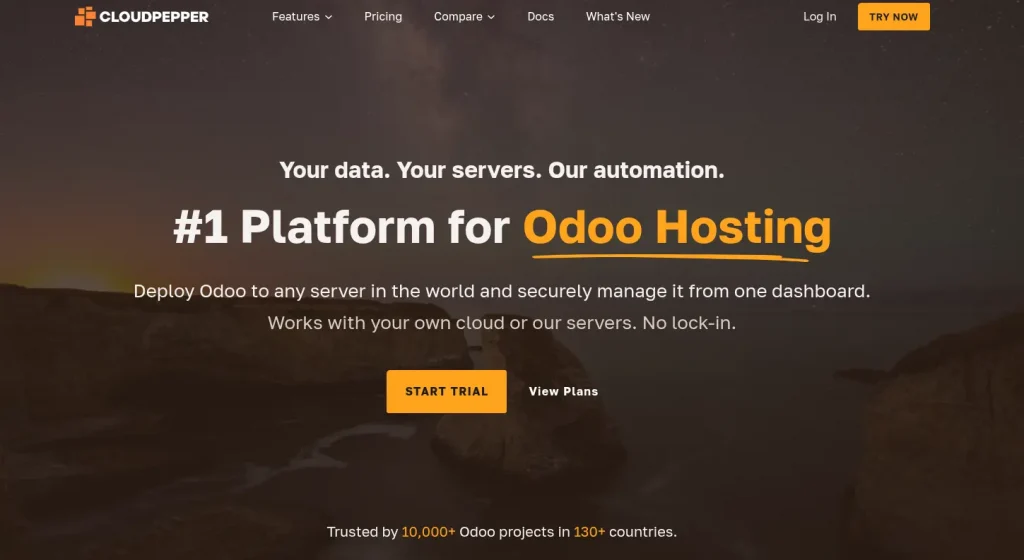
CloudPepper offers two distinct approaches to Odoo hosting, giving you flexibility based on your infrastructure preferences.
Their Managed Hosting plans include servers hosted by CloudPepper, providing a complete all-in-one solution. Their DevOps plans let you connect your own cloud provider (AWS, DigitalOcean, Vultr, or even on-premise servers) while CloudPepper handles all the management.
This dual approach addresses different business needs: some want completely hands-off hosting, while others prefer owning their infrastructure for compliance or cost reasons but still want professional management.
How CloudPepper Works
Managed Hosting: Select a server configuration directly through CloudPepper’s dashboard and start using Odoo immediately. The server is included in your plan, and CloudPepper handles everything from setup to ongoing maintenance.
DevOps Plans: Connect your existing cloud provider account (or on-premise servers) to CloudPepper’s platform. They provision and manage Odoo servers through their management interface, while all your data and infrastructure remain in your account. If you cancel their service, your servers and data stay intact with your cloud provider—no vendor lock-in.
Both approaches provide unlimited staging environments, automated backups, Git deployment from any repository, and access to 900+ free third-party Odoo addons.
Pros of CloudPepper
- Flexible infrastructure options – Choose managed hosting or bring your own cloud provider
- No vendor lock-in – DevOps plans let you keep infrastructure if you cancel
- Dedicated resources – Every deployment gets isolated server resources, no performance sharing
- Unlimited staging environments – Test changes before pushing to production
- Git deployment – Deploy from any Git repository (GitHub, GitLab, Bitbucket, or any provider)
- Direct database access – Full PostgreSQL access for custom queries and optimization
- Unlimited custom modules – No restrictions on third-party apps or customizations
- Flexible backup options – Choose any S3/SFTP provider or use CloudPepper’s backup service ($0.02/GB)
- No user restrictions – Add unlimited users (actual capacity depends on server resources)
- Both Community and Enterprise – Support for both Odoo editions
- Easy migration – Migrate from any hosting provider, on-premise, odoo.com, or odoo.sh
- 900+ free addons – Access to curated third-party Odoo modules
Cons of CloudPepper
- DevOps plans require a cloud provider account (though this provides infrastructure ownership)
- Learning curve for managing multiple environments if you’re new to staging/production workflows
Best For
Managed Hosting plans work well for businesses wanting completely hands-off hosting without managing cloud accounts, small to medium businesses needing reliable hosting with professional support, and teams wanting to focus on using Odoo rather than managing infrastructure.
DevOps plans excel for Odoo partners managing multiple client deployments, businesses requiring specific cloud providers for compliance reasons, organizations concerned about vendor lock-in, and companies wanting infrastructure ownership without DevOps overhead.
Both options benefit businesses needing dedicated resources, unlimited staging environments, and full customization freedom.
Pricing
CloudPepper offers a free Core plan that lets you run one Odoo instance on any cloud provider.
Managed Hosting (Server Included):
- Base: $41/month – All-in-one Odoo hosting
- Pro: $61/month – Unlimited Odoo servers for a flat fee
- Agency: $262/month – White-label features for Odoo partners
DevOps Plans (Your Own Infrastructure):
- Base: $29/month – All-in-one Odoo server management
- Pro: $49/month – Unlimited servers for a flat fee
- Agency: $250/month – White-label features for Odoo partners
With Pro and Agency plans, you can create unlimited Odoo servers, instances, and staging environments at no extra cost. For DevOps plans, the only additional expense is the server cost from your cloud provider (starting around $5-12/month for basic configurations).
Comparing CloudPepper Features
| Feature | CloudPepper Pro (DevOps) | CloudPepper Pro (Managed) | Traditional Managed Hosting |
|---|---|---|---|
| Monthly Price | $49 + cloud costs | $61 (server included) | $150-300+ |
| Server Ownership | You own via a cloud provider | CloudPepper manages | Provider owns |
| Vendor Lock-in | None | Low | High |
| Staging Environments | Unlimited | Unlimited | Limited or extra cost |
| Git Integration | Any repository | Any repository | Often restricted |
| Database Access | Direct PostgreSQL access | Direct PostgreSQL access | Often restricted |
| Custom Modules | Unlimited | Unlimited | May be restricted |
| Cloud Provider Choice | Any provider/on-premise | CloudPepper servers | Fixed infrastructure |
2. Unmanaged VPS Hosting
Unmanaged VPS hosting represents the most cost-effective option for organizations with technical expertise. Providers like SSD Nodes, DigitalOcean, Vultr, and Linode (now Akamai) offer bare-bones virtual servers where you handle all configuration, security, maintenance, and troubleshooting yourself.
The Economics of Self-Management
Where managed providers charge $50-150/month for mid-range configurations, unmanaged alternatives start at $4-12/month for comparable hardware. A server with 2 vCPUs, 4GB RAM, and 80GB SSD storage might cost $12/month unmanaged versus $70/month managed. Over a year, that’s $144 versus $840 for functionally identical infrastructure.
However, you become your own DevOps team, handling Linux administration, PostgreSQL management, security hardening, backup systems, and troubleshooting. Expect 5-15 hours monthly for experienced administrators.
Pros of Unmanaged VPS
- Maximum cost efficiency – 60-80% savings versus managed alternatives
- Complete control – Configure and optimize everything for your needs
- No vendor restrictions – Install any software, use any tools
- Unlimited customization – Custom caching, database tuning, optimizations
Cons of Unmanaged VPS
- Time investment – Ongoing management requires dedicated resources
- Technical expertise required – Linux, PostgreSQL, security knowledge needed
- Security responsibility – All hardening and monitoring is on you
- No support safety net – You fix everything yourself
Best For
Organizations with experienced Linux administrators, technical founders comfortable with command-line operations, Odoo development shops needing multiple test environments, and startups optimizing for low burn rate with technical co-founders.
Pricing
Entry-level servers (1 vCPU, 2GB RAM) run $4-6/month. Production configurations (2 vCPUs, 4GB RAM, 80GB SSD) cost $10-20/month. Mid-range servers (4 vCPUs, 8GB RAM) run $20-40/month.
3. Amazon Web Services (AWS)
Deploying Odoo on AWS provides maximum control and unlimited customization possibilities. AWS’s infrastructure-as-a-service model lets you architect your Odoo environment exactly as needed, from simple single-server deployments to sophisticated multi-region architectures serving global users.
How AWS Deployment Works
On AWS, you’re building your Odoo infrastructure from the ground up. This means selecting EC2 instance types, configuring RDS for PostgreSQL, setting up S3 for file storage, implementing CloudFront for content delivery, and managing security groups and networking.
The flexibility is comprehensive, but so is the responsibility. You’ll need expertise in Linux server administration, PostgreSQL optimization, AWS networking, security hardening, and backup strategies.
Pros of AWS
- Unlimited customization – Configure every aspect of your infrastructure
- Auto-scaling – Automatically add resources during traffic spikes
- Global infrastructure – Deploy servers in regions closest to your users
- Advanced features – Elastic Load Balancing, Virtual Private Clouds, and advanced networking
- Integration ecosystem – Connect with other AWS services like Lambda, SageMaker, or analytics tools
- Enterprise certifications – Extensive compliance certifications for regulated industries
- High availability – Design fault-tolerant architectures with automatic failover
Cons of AWS
- Technical complexity – Requires significant DevOps expertise
- Steep learning curve – AWS services have extensive configuration options
- Cost management – Pricing can be complex and unpredictable without careful monitoring
- Time investment – Ongoing management requires dedicated resources
- Security responsibility – You handle all security configurations and monitoring
Best For
AWS makes sense for large enterprises with existing cloud infrastructure, organizations requiring complex custom architectures, businesses with internal DevOps capabilities, and companies needing specific compliance certifications or global deployment.
Most organizations choosing AWS either have dedicated DevOps teams or partner with implementation specialists who handle infrastructure alongside Odoo customization.
Pricing
AWS pricing varies dramatically based on your architecture choices. A basic production-ready setup might cost $100-300/month, while enterprise deployments with high availability, auto-scaling, and global distribution can run thousands monthly. The pay-as-you-go model means you only pay for resources actually consumed.
Technical Requirements for AWS
Successfully running Odoo on AWS requires:
- Linux system administration (Ubuntu/Debian preferred)
- PostgreSQL database optimization and management
- AWS networking (VPC, security groups, route tables)
- Load balancing and auto-scaling configuration
- Backup and disaster recovery implementation
- Security hardening and monitoring
- Cost optimization and resource management
4. Odoo.sh

Odoo.sh is the official Platform-as-a-Service directly from Odoo. It provides the tightest possible integration with Odoo’s ecosystem and receives new features and updates before any third-party hosting provider.
The platform is purpose-built exclusively for Odoo Enterprise editions, which means everything from deployment workflows to performance optimization is designed specifically for Odoo workloads.
How Odoo.sh Works
Odoo.sh operates on a shared hosting model where infrastructure resources are shared among multiple customers. The platform integrates directly with GitHub for version control and provides automated deployment workflows that many development teams appreciate.
For businesses committed to Odoo Enterprise without heavy customizations, it offers a turnkey solution that handles everything automatically.
Pros of Odoo.sh
- Official platform – Direct support from Odoo with guaranteed compatibility
- Seamless Odoo Studio integration – Build customizations with no-code tools
- First access to new features – Updates arrive on Odoo.sh before other platforms
- Automated deployment – Push to GitHub, and changes deploy automatically
- Integrated development workflow – Development, staging, and production environments built in
- Hands-off management – Minimal technical expertise required
- Enterprise-grade support – Direct access to Odoo support teams
Cons of Odoo.sh
- Shared hosting resources – Performance can vary during peak usage periods
- GitHub requirement – Only works with GitHub, not GitLab or Bitbucket
- Enterprise-only – Does not support Odoo Community Edition
- Limited resource control – Cannot directly access or optimize server configurations
- Scaling costs – Additional resources beyond base allocations incur extra charges
- Vendor lock-in – Migration away from Odoo.sh requires significant effort
Best For
Odoo.sh excels for businesses fully committed to Odoo Enterprise, organizations wanting official support and guaranteed compatibility, teams using GitHub for version control, and companies preferring completely hands-off infrastructure management.
If you’re running standard Odoo implementations without extensive customizations, the simplicity and tight integration make Odoo.sh compelling despite the premium pricing.
Pricing
Odoo.sh starts around $57.80/month per user for basic plans. Additional costs apply for hosting resources beyond base allocations, including backup storage. The per-user pricing model means costs scale linearly with team size, which can become expensive for larger organizations.
Making Your Decision: Key Considerations
1. Assess Your Technical Capabilities
Be honest about your team’s technical depth. If nobody can troubleshoot Linux servers or PostgreSQL issues, consider managed solutions like CloudPepper or Odoo.Sh makes more sense than AWS or unmanaged VPS.
2. Understand Your Growth Trajectory
Odoo.sh uses per-user pricing that scales with headcount. CloudPepper offers flat-rate unlimited management. AWS provides virtually unlimited scaling but requires technical expertise. Consider where you’ll be in two or three years.
3. Factor in Total Cost of Ownership
Calculate fully loaded costs, including monthly hosting charges, internal staff time, backup expenses, security monitoring, and support costs. A cheaper option requiring 10 hours monthly of IT time may cost more than a hands-off managed solution.
4. Consider Compliance and Data Residency
CloudPepper lets you choose any cloud provider in any region. AWS offers extensive compliance certifications globally. Match your regulatory requirements to your hosting choice.
The Bottom Line
There’s no universally “best” Odoo hosting provider. The right choice depends on your specific situation, technical capabilities, budget, and business requirements.
CloudPepper excels for organizations wanting infrastructure ownership without management overhead, offering dedicated resources and zero vendor lock-in at predictable flat rates.
Unmanaged VPS hosting delivers maximum cost efficiency for technically capable teams willing to handle their own DevOps.
AWS offers maximum control and unlimited customization for organizations with technical expertise and complex requirements.
Odoo.sh provides the tightest integration and simplest experience for Enterprise users committed to the official platform.
The hosting environment you choose will support your business operations for years to come. Taking time to select the right approach saves headaches, money, and frustration down the road while enabling Odoo to deliver its full value to your organization.

manvinder Singh
https://www.hostingseekers.com
Manvinder Singh is the Founder and CEO of HostingSeekers, an award-winning go-to-directory for all things hosting. Our team conducts extensive research to filter the top solution providers, enabling visitors to effortlessly pick the one that perfectly suits their needs. We are one of the fastest growing web directories, with 500+ global companies currently listed on our platform.