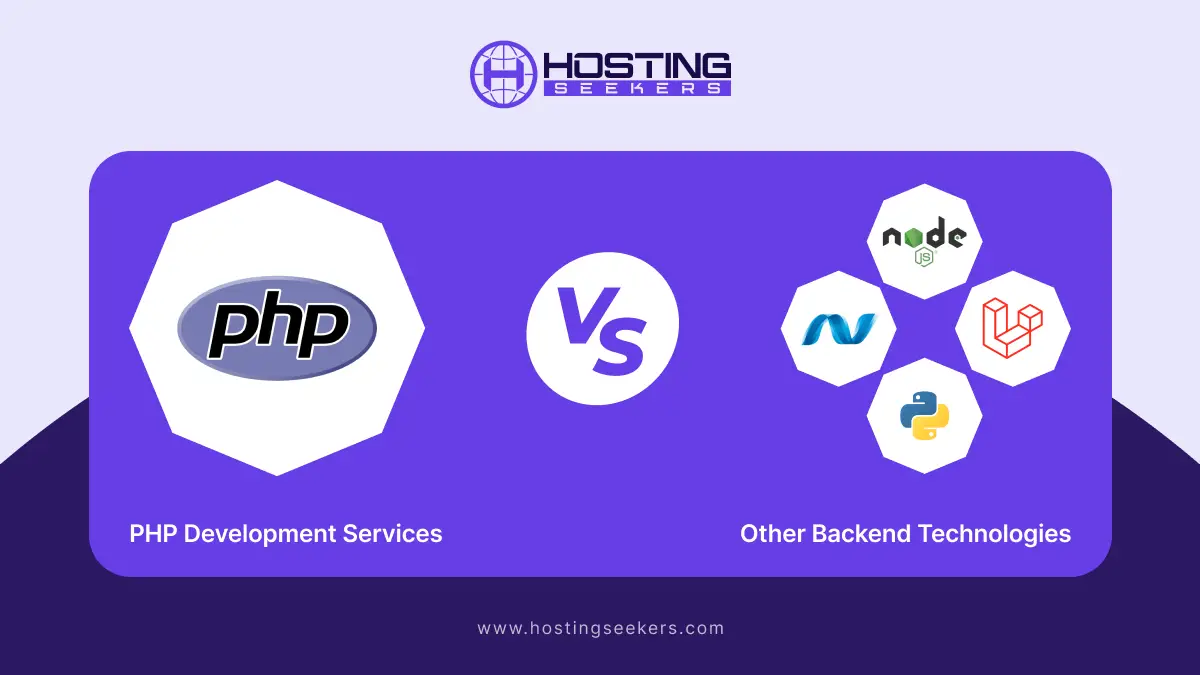
PHP Development Services vs Other Backend Technologies
Development Published on : February 25, 2026In 2026, PHP remains one of the most widely used and reliable backend technologies despite the rise of alternatives such as Node.js, Python, Ruby on Rails, and Java frameworks. Its long-standing presence, vast ecosystem, and ongoing evolution make it highly relevant in modern web development. Let’s explore how PHP stacks up against other major technologies and help you pick the best for your project.
Why PHP Still Matters in 2026
PHP remains one of the top backend languages powering millions of websites worldwide, including major CMS platforms like WordPress, which alone powers roughly 40–45% of all sites on the web.
Here are the key strengths that keep PHP in the conversation:
1. Fast Time-to-Market & Developer Productivity
PHP frameworks like Laravel and Symfony offer robust built-in tools for authentication, routing, templating, caching, and more, helping developers launch applications quickly. Laravel in particular is praised for its clean syntax and productivity benefits, making PHP feel modern and efficient.
2. Cost-Effective & Open-Source
PHP is free to use and open source, with no licensing fees, and supported by virtually all hosting providers. This drastically reduces costs for startups and enterprises alike.
3. Huge Ecosystem & Community
PHP’s ecosystem includes many frameworks (Laravel, Symfony, Yii, CodeIgniter), CMS platforms (WordPress, Drupal), and libraries/plugins, making it easy to find ready-made solutions for everyday needs.
4. Wide Adoption & Stability
PHP has been around for over 25 years and powers a significant portion of the web. According to recent stats, PHP is still among the top 10 most used languages and reliably powers large platforms.
PHP Development Services vs Other Technologies in 2026
PHP vs Node.js
Node.js is widely chosen for applications that demand real-time communication, such as chat platforms, collaborative tools, and live dashboards. Its event-driven, non-blocking architecture makes it ideal for handling large numbers of simultaneous connections, and it performs well in microservices-based and API-first systems that rely heavily on asynchronous workflows.
PHP, however, remains a more practical option for traditional server-rendered websites and content-driven platforms. It is easier to host and deploy, as it does not require complex service orchestration or long-running processes. With frameworks like Laravel and Symfony, PHP enables faster development for typical business websites, e-commerce platforms, and CMS-based projects.
PHP vs Node.js Short Comparison
| Parameter | PHP | Node.js |
| Type / Nature | Server-side scripting language (Hypertext Preprocessor) | Server-side JavaScript runtime environment |
| Initial Release | 1994 | 2009 |
| Syntax / Language | PHP syntax (similar to C) | JavaScript syntax |
| File Extension | .php | .js |
| Execution Model | Synchronous (blocking) | Asynchronous, non-blocking I/O |
| Command Line Access | $ php -i | $node |
| Context / Stack | Often part of the LAMP stack (Linux, Apache, MySQL, PHP) | JavaScript across client & server (MEAN/MERN stacks) |
| Modules / Package Manager | Uses PEAR, Composer | Uses NPM (Node Package Manager) |
| Frameworks | Laravel, CodeIgniter, CakePHP, etc. | Express, Meteor, Koa, Hapi, etc. |
| Database Usage | Commonly with MySQL, MariaDB, and PostgreSQL (SQL) | Works well with NoSQL (MongoDB, CouchDB, Neo4j) |
PHP vs Python
When comparing PHP and Python for web development, the choice often depends on the application’s primary goal. Both languages are mature, widely supported, and capable of powering large-scale platforms, but they shine in different areas.
Python is widely preferred in environments where data processing, artificial intelligence, and machine learning play a significant role. Its rich ecosystem of libraries, including NumPy, Pandas, TensorFlow, and Porch, makes it an excellent choice for applications that require analytics, automation, or AI-driven capabilities. Frameworks like Django and Flask further strengthen Python’s position in API development and backend services by offering clean architecture, rapid growth, and easy integration with modern technologies. Python’s simple and highly readable syntax also reduces development complexity, making it popular among teams working on data-centric or research-oriented platforms.
PHP vs Python: Short Comparison
| Features | PHP | Python (Django / Flask) |
| Primary Use | Designed mainly for server-side web development and content-based websites | General-purpose language widely used for web apps, APIs, data science, and AI |
| Learning Curve | Easy to start, especially for web developers | Very beginner-friendly with clean, readable syntax |
| Frameworks | Laravel, Symfony, CodeIgniter, CakePHP | Django, Flask, FastAPI |
| Performance | Optimized for web workloads and fast page rendering | Slightly slower for raw web output, but powerful for data processing |
| Ecosystem | Huge CMS and hosting ecosystem (WordPress, Magento, Joomla) | Massive library support for AI, ML, automation, and analytics |
| Web Focus | Built specifically for web content and websites | Built for many domains beyond the web |
| Database Support | Excellent support for MySQL, MariaDB, and PostgreSQL | Strong ORM support and easy integration with SQL & NoSQL databases |
| Scalability | Scales well for traditional web apps and CMS platforms | Scales well for APIs, microservices, and data-driven systems |
PHP vs Ruby on Rails
Ruby on Rails is known for its convention-over-configuration approach, which allows developers to build applications quickly with minimal setup. It is often used by startups and product teams that need to validate ideas and launch MVPs quickly.
PHP, however, benefits from broader adoption, a larger developer community, and lower infrastructure costs. It is easier to deploy across shared, VPS, and cloud hosting environments, and it generally performs better under heavy traffic when properly optimized. While Ruby on Rails is excellent for rapid prototyping, PHP is usually the more economical and scalable option for long-term production systems.
| Feature | PHP | Ruby on Rails |
| Language Type | General-purpose scripting language | Full-stack web framework based on Ruby |
| Learning Curve | Easy to moderate, widely taught | Moderate to steep due to Ruby on Rails conventions |
| Development Speed | Fast with frameworks like Laravel, Symfony | Very fast due to convention over configuration |
| Performance | High performance, especially with PHP 8+ | Slower than PHP for heavy traffic applications |
| Scalability | Scales well for small to enterprise websites | Scales well but needs strong server optimization |
| Community & Support | Huge global community | Smaller but highly skilled community |
| Ecosystem | Huge CMS, libraries, plugins, frameworks | Rich gems ecosystem, but smaller than PHP |
| Hosting Cost | Low, supported by most shared hosts< | Higher requires a VPS or cloud setup |
| Security | Strong with modern frameworks & updates | Strong built-in security defaults |
PHP vs Java (Spring Boot)
Java, especially with Spring Boot, is commonly used for enterprise-grade systems that require high reliability, strict security, and complex business logic. Its strong security, mature tooling, and support for microservices make it suitable for large-scale, mission-critical applications.
PHP stands out for its simplicity, faster learning curve, and significantly lower development and maintenance costs. It is better suited for standard web applications, including content platforms, online stores, and business websites that do not require heavy enterprise infrastructure. Java is the right choice for complex corporate systems and distributed architectures, while PHP remains ideal for content-centric and customer-facing platforms.
| Feature | PHP | Java (Spring Boot) |
| Primary Use | Web applications, CMS, eCommerce | Enterprise systems, microservices |
| Learning Curve | Easy and beginner-friendly | Steep and more complex |
| Development Speed | Faster for typical web apps | Slower due to complex setup |
| Performance | Excellent for content-driven apps | High performance for large systems |
| Scalability | Scales well for web platforms | Designed for large-scale architectures |
| Hosting Cost | Low, widely supported | Higher infrastructure cost |
| Deployment | Simple shared/VPS hosting | Requires JVM, containers, and cloud setups |
| Best For | Business websites, SaaS, portals | Banking, ERP, large enterprise apps |
When to Select PHP Development Services?
PHP development services are the right choice when your project requires a balance of performance, affordability, scalability, and fast delivery. PHP is especially well-suited to business-focused, content-driven platforms where stability and long-term maintainability matter. If your project requires rapid development with modern architecture, choosing specialized Laravel development services can help you build secure, scalable, and API-ready applications.
Choose PHP if you are building:
1. Business Websites
PHP is ideal for corporate websites, service portals, and company landing pages that require strong performance, security, and SEO support. With frameworks like Laravel and CMS platforms like WordPress, businesses can launch quickly and scale easily.
2. CMS Platforms
PHP powers the world’s most popular content management systems, such as WordPress, Drupal, and Joomla. If your project relies on frequent content updates, blogging, SEO tools, or editorial workflows, PHP offers unmatched flexibility and plugin support.
3. eCommerce Stores
PHP is widely used in eCommerce platforms like Magento, WooCommerce, OpenCart, and PrestaShop. It supports secure payment gateways, inventory management, and high traffic loads, making it a trusted solution for online stores.
4. Membership Portals
PHP frameworks provide built-in authentication, role management, and access control features. This makes PHP perfect for building learning platforms, subscription-based websites, and community portals.
5. SaaS Platforms
With modern PHP frameworks, businesses can build scalable SaaS applications that support multi-user access, API integration, and cloud deployment. PHP’s cost-efficiency makes it ideal for startups and growing businesses.
Why PHP Works Best
PHP is ideal when you need a backend that is easy to maintain, affordable to scale, and quick to deploy. Its large developer community, hosting flexibility, and framework ecosystem ensure long-term reliability.
When to Choose Other Backend Technologies
While PHP is versatile, some projects require specialized backend technologies. In such cases, alternative stacks may be more suitable.
1. Choose Node.js for Real-Time Applications
Node.js is the best choice for applications that require real-time data processing, such as chat apps, live streaming platforms, gaming servers, and collaboration tools. Its event-driven architecture efficiently handles high concurrency.
2. Choose Python for AI & Data-Driven Platforms
Python is ideal for applications involving artificial intelligence, machine learning, data analytics, and automation. Frameworks like Django and Flask integrate easily with AI and data processing tools.
3. Choosing Ruby on Rails for MVP Development
Ruby on Rails is ideal for startups looking to quickly build and launch a minimum viable product. Its convention-based development approach reduces coding time and enables faster validation of ideas.
4. Choosing Java for Enterprise Systems
Java with Spring Boot is best for large-scale enterprise platforms that require high security, complex business logic, and microservices architecture. It is widely used in banking, healthcare, and large corporate systems.
Final Verdict
In 2026, PHP development services remain among the most practical, reliable, and cost-effective backend solutions for businesses of all sizes. While newer backend technologies such as Node.js, Python, Ruby on Rails, and Java offer powerful capabilities for specialized use cases, PHP remains the most balanced option for organizations seeking long-term value. PHP’s strength lies in its mature ecosystem, proven scalability, and business-ready stability. With modern frameworks like Laravel and Symfony, PHP now delivers performance, security, and flexibility on par with newer stacks without the high development and infrastructure costs often associated with them. Its compatibility with cloud hosting, containerization, and microservices architectures ensures that PHP remains future-ready.
Frequently Asked Questions
Q 1. Is PHP still relevant in 2026?
Ans. Yes, PHP is still highly relevant in 2026. It powers a large portion of the web and continues to evolve with modern frameworks like Laravel and Symfony, making it secure, fast, and scalable for business applications.
Q 2. Which is better for startups: PHP or Ruby on Rails?
Ans. Ruby on Rails is often preferred for rapid MVP development, while PHP is better for startups that want long-term scalability, lower costs, and easier hiring.
Q 3. Is PHP suitable for enterprise-level applications?
Ans. Yes, with frameworks like Laravel and Symfony, PHP is widely used for enterprise-grade platforms, large websites, SaaS systems, and eCommerce applications.
Q 4. What makes PHP more cost-effective than other backend technologies?
Ans. PHP offers low hosting costs, a large developer pool, open-source frameworks, and easy maintenance, which significantly reduces development and operational expenses.
Q 5. Can PHP handle high-traffic websites?
Ans. Absolutely, PHP can scale efficiently using caching, load balancing, and cloud hosting, making it suitable for high-traffic platforms like eCommerce stores and SaaS products.

manvinder Singh
https://www.hostingseekers.com
Manvinder Singh is the Founder and CEO of HostingSeekers, an award-winning go-to-directory for all things hosting. Our team conducts extensive research to filter the top solution providers, enabling visitors to effortlessly pick the one that perfectly suits their needs. We are one of the fastest growing web directories, with 500+ global companies currently listed on our platform.