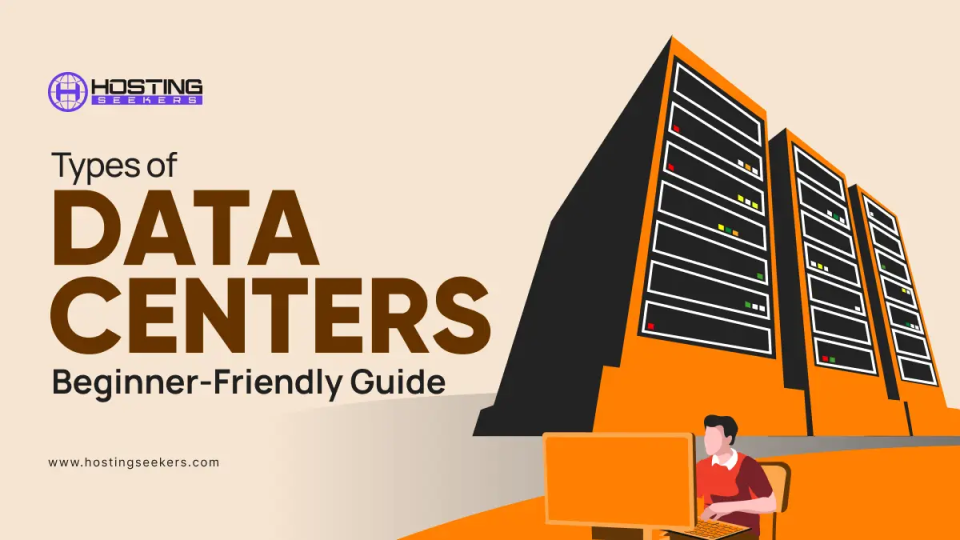
Types of Data Centers: Beginner-Friendly Guide (2026 Edition)
IT Updated on : March 3, 2026Having a basic understanding of how data centers function helps explain how many of today’s services are delivered. Every time you stream a movie, open a website, or use a cloud app, a data center is working behind the scenes to keep everything running smoothly.
But not all data centers are the same, as some power global tech giants, while others support small businesses, local services, or specific government operations.
In this beginner-friendly 2026 edition, we break down the different types of data centers in simple terms, explain how they work, and help you understand which types dominate today’s fast-growing digital landscape. Whether you are a student, tech enthusiast, or business owner, this guide provides a clear foundation for navigating modern data centers.
As of 2025, there are around 5427 data centers in the United States, the most of any country worldwide. A further 529 were located in Germany, while 487 were in the United Kingdom.
Data Centers Each Country Has (Nov 2025)
| Rank | Country | Number of Data Centers (Nov 2025) |
| 1 | United States | 5,427 |
| 2 | Germany | 529 |
| 3 | United Kingdom | 523 |
| 4 | China | 449 |
| 5 | Canada | 337 |
| 6 | France | 322 |
| 7 | Australia | 314 |
| 8 | Netherlands | 298 |
| 9 | Russia | 251 |
| 10 | Japan | 222 |
| 11 | India | 153 |
Global Data Center Market Size
The global data center industry is experiencing powerful, sustained growth. In 2025, the market was estimated at $527.46 billion, and current projections place it at $739.05 billion by 2030, supported by a steady 6.98% CAGR, according to Statista.
Yet the real story lies in how rapidly organizations are investing in infrastructure. Gartner’s latest figures show data center systems spending skyrocketing to $489.5 billion in 2025, a massive 46.8% leap from $333.4 billion in 2024. This surge underscores the accelerating demand for AI-driven workloads, high-performance computing environments, and next-generation cloud ecosystems.
The global data center market shows a highly uneven but strategically important regional distribution. While the U.S. continues to dominate due to its massive hyperscale ecosystem and AI infrastructure investments, Europe and China also maintain strong positions driven by cloud adoption, regulatory requirements, and rapid digital transformation. Meanwhile, the Rest of the World collectively surpasses every individual region, reflecting the accelerating expansion of data centers in emerging markets, including India, Southeast Asia, and the Middle East.
Global Data Center Market Size by Region (2025)
| Region | Market Size | % of Global Market |
| United States | $171.90B | 33% |
| Europe | $89.67B | 17% |
| China | $84.39B | 16% |
| Rest of World | $181.50B | 34% |
| Global Total | $527.46B | 100% |
What Do Data Centers Do?
Data centers act as the backbone of the digital world. They are highly engineered facilities designed to store, process, deliver, and protect data on a massive scale. Every digital service we rely on, whether it’s browsing a website, making an online payment, watching a video, or running an AI-powered app, is supported by the infrastructure inside a data center.
At their core, data centers host thousands of interconnected servers, networking devices, and storage systems. These components work together to perform essential tasks such as:
- Storing data: Everything from emails and documents to apps and enterprise databases.
- Processing information: Running applications, analytics, workloads, AI models, and business operations.
- Delivering services globally: Ensuring users can access websites, apps, and content quickly and reliably.
- Protecting data: Using firewalls, encryption, access controls, and surveillance systems to safeguard digital assets.
To ensure uninterrupted operations, data centers are built with redundant power, advanced cooling systems, and failover mechanisms. This means that if one component fails, another immediately takes over without downtime.
In simple terms, data centers function as the “engine room” of the internet, keeping the modern digital ecosystem running smoothly 24/7, powering everything from small business applications to large-scale cloud platforms, fintech systems, AI workloads, and global online services.
Types of Data Centers
1. Colocation
A colocation (or “colo”) data center is a facility where businesses rent physical space to place their own servers and hardware. The provider supplies the building, racks, power, cooling, internet connectivity, and security while the customer controls their equipment.
How It Works
Companies bring their own servers and install them on-site. The provider ensures uptime, network redundancy, and 24/7 security.
Best For
- Businesses want complete control of their hardware without owning a facility.
- Growing companies need scalable space.
- Enterprises requiring compliance-ready environments.
- Organizations running hybrid cloud setups.
2. AI Data Center
AI data centers are high-performance, GPU-dense facilities designed to support heavy AI/ML workloads, including model training, LLMs, big data analytics, and HPC (High-Performance Computing).
How It Works
They use high-density racks, liquid cooling, advanced power systems, and high-speed networking (InfiniBand) to support massive computer clusters.
Best For
- AI startups building or training models.
- Enterprises run large AI/ML workloads.
- Autonomous vehicle companies.
- Research labs and supercomputing projects.
3. Enterprise Data Center
Enterprise data centers are owned and operated by a single organization, typically located on-site or at the company’s own facility. They support internal IT operations and mission-critical systems.
How It Works
The company designs, builds, and manages the data center according to its operational, security, and compliance needs.
Best For
- Large enterprises with strict data governance.
- Organizations need customized infrastructure.
- Businesses handling sensitive data (finance, healthcare, government).
- Companies require complete control over security and compliance.
4. Managed Data Center
In a managed data center, the provider controls the operations, monitoring, maintenance, security, and optimization of the entire infrastructure. The customer pays for services without managing the technical side.
How It Works
Businesses outsource data center management tasks such as patching, monitoring, backups, and disaster recovery, while using dedicated or shared infrastructure.
Best For
- Businesses without dedicated IT teams.
- SMEs want predictable costs.
- Companies seeking managed hosting or managed cloud.
- Organizations want to avoid the complexity of self-management infrastructure.
5. Cloud Data Center
Cloud data centers host virtualized infrastructure delivered over the internet. These facilities power major cloud platforms where users access computer, storage, networking, and applications on demand.
How it works
Instead of using physical servers, users work with virtual machines, containers, or cloud services. Resources scale automatically based on workload demand.
Best For
- Startups and enterprises need instant scalability.
- Businesses running SaaS, PaaS, or IaaS workloads.
- Organizations shifting from CapEx to OpEx.
- Companies with global teams or distributed applications.
6. Micro Data Center
Micro data centers are small, modular, self-contained units designed for edge computing. They bring computing power closer to users or devices to reduce latency.
How It Works
These units can be deployed anywhere, including retail stores, manufacturing floors, hospitals, cell towers, or remote locations. They support IoT, 5G, and real-time data processing.
Best For
- Edge computing environments.
- Smart cities, autonomous systems, and IoT networks.
- Factories using real-time automation.
- Retail, healthcare, telecom, and remote sites need local processing.
Benefits of Data Centers
High Performance
Data centers are built with powerful servers, fast networking, and optimized infrastructure, enabling them to handle demanding workloads such as analytics, enterprise applications, large databases, media streaming, and AI tasks without slowdowns. This ensures that businesses deliver smooth, responsive user experiences.
Security and Compliance
Data centers implement multi-layered security measures, both physical and logical. From surveillance systems and biometric access controls to firewalls and encryption, these facilities are designed to protect sensitive information. Many data centers also comply with strict industry standards (such as ISO, PCI-DSS, HIPAA), helping organizations meet regulatory requirements.
Business Continuity
One of the core strengths of data centers is their ability to keep operations running even when issues arise. Redundant power supplies, backup generators, cooling systems, and failover mechanisms ensure services remain available during outages, hardware failures, or disasters. This minimizes downtime and protects business operations.
Scalability
Data centers allow organizations to scale up or down based on demand. Whether a business needs more storage, greater processing power, or additional network capacity, data centers provide flexible resources that can be expanded quickly without significant infrastructure changes.
Cost Efficiency
Building a private data center is extremely expensive. By using shared, colocation, or cloud data centers, companies significantly reduce capital expenditure (CapEx). Instead of buying hardware, they pay for resources as needed, lowering overall IT costs and freeing budgets for other priorities.
Global Reach
Cloud and hyperscale data centers are distributed across multiple regions worldwide. This lets businesses deliver content and services closer to users, reducing latency and improving speed. It also supports global operations, remote teams, and multi-region application deployment.
What are the Essential Components of a Data Center?
A fully functioning data center relies on a combination of hardware, software, power, cooling, and security systems. Each component plays a crucial role in maintaining efficient, reliable operations.
1. Servers
Servers are the core computing units of a data center. They run applications, handle user requests, process data, and support workloads such as virtualization, AI training, web hosting, and enterprise systems.
2. Storage Systems
Storage systems hold the organization’s data from files and databases to backups and virtual machine images. These systems may include SAN (Storage Area Network), NAS (Network Attached Storage), or cloud storage solutions, designed for reliability and easy scalability.
3. Networking Equipment
Connectivity is the backbone of a data center. Networking devices, including routers, switches, firewalls, load balancers, and cabling, ensure data moves efficiently between servers, users, and external networks. They also enforce security and manage traffic distribution.
4. Power Systems
Data centers require continuous, stable power. This is achieved through:
- UPS (Uninterruptible Power Supplies) for immediate backup
- Generators for long-term power during outages
- PDUs (Power Distribution Units) to safely distribute electricity
- Redundant circuits to prevent interruptions
These systems guarantee uninterrupted service even during grid failures.
5. Cooling & HVAC
Servers generate significant heat, and without proper cooling, they can fail. Cooling systems such as CRAC/CRAH units, liquid cooling, and airflow management regulate temperature and humidity. This ensures optimal performance and extends the hardware lifespan.
6. Physical Security
Strict physical security prevents unauthorized access. Common protections include:
- Biometric scanners
- Mantraps
- CCTV surveillance
- Security guards
- Alarm systems
This safeguards both the facility and the data stored inside.
7. Monitoring & Management Software
Data centers rely on advanced software tools to monitor performance, energy usage, temperature, network health, security events, and hardware conditions. These tools provide real-time alerts and analytics to help IT teams prevent issues before they impact users.
Data Center Design Standards
1. Uptime Institute Tier Standards
The Uptime Institute’s Tier system is one of the most important and globally recognized frameworks for rating data center reliability and resilience. It classifies data centers into four tiers based on redundancy, availability, and fault tolerance.
Tier I – Basic Capacity
- Designed for small businesses or non-critical workloads.
- Limited or no redundancy
- Expected availability: 99.671%
- Suitable for simple IT setups
Tier II – Redundant Components
- Adds redundant power and cooling components
- Higher reliability than Tier I
- Expected availability: 99.749%
- Reduces risk of downtime for moderate workloads
Tier III – Concurrently Maintainable
- All systems can be serviced without shutting down operations.
- Provides full redundancy across major components.
- Expected availability: 99.982%
- Ideal for enterprises requiring continuous operations.
Tier IV – Fault-Tolerant
- Highest level of resilience and redundancy.
- Can sustain failures without impacting operations
- Expected availability: 99.995%
- Suited for mission-critical environments like banks, trading firms, and healthcare systems
2. ANSI/BICSI 002
ANSI/BICSI 002 provides detailed guidelines for planning, designing, building, and operating data centers. It covers architecture, electrical systems, cooling, network design, security, and operations.
Key Features
- Addresses both physical and IT infrastructure
- Sets best practices for cabling, airflow, and equipment layout
- Helps organizations optimize performance, safety, and efficiency
- Used widely by architects, engineers, and data center operators
This standard ensures facilities are built with a strong focus on longevity, sustainability, and operational excellence.
3. TIA-942 (Telecommunications Infrastructure Standard)
TIA-942 is one of the most comprehensive standards specifically focused on a data center’s telecommunications and network infrastructure.
Key Features
- Defines cabling systems (fiber, copper, pathways)
- Provides guidelines for network redundancy and fault tolerance
- Includes physical layout recommendations for network and server rooms
- Introduces its own rating system: Rated 1–4 (similar to Tier levels)
TIA-942 is widely adopted because it ensures high-performance connectivity, which is critical for modern workloads.
4. ISO/IEC 27001 & ISO/IEC 20000
These international standards focus on security and IT service management, ensuring data centers meet globally accepted best practices.
ISO/IEC 27001 – Information Security Management
- Covers risk management, data protection, and security controls
- Ensures sensitive information is handled properly
- Demonstrates strong organizational commitment to security
ISO/IEC 20000 – IT Service Management
- Focuses on service quality, reliability, and delivery processes
- Helps organizations manage IT operations effectively
- Enhances customer confidence and operational stability
Together, these standards ensure that data centers maintain strong security, consistent service quality, and operational discipline.
How to Select a Data Center Type?
1. Evaluate Your Business Size & Growth Plans
Your organization’s current scale and expected growth trajectory significantly influence the type of data center you should choose. Small businesses and startups often benefit from cloud or managed data centers because they require minimal upfront investment and allow quick deployment.
Mid-sized companies generally need more predictable performance and better control over infrastructure, making colocation or enterprise data centers more suitable. Large enterprises, on the other hand, tend to rely on enterprise or AI data centers due to their ability to handle massive workloads, automation-driven processes, and highly complex operations. This step helps you determine which infrastructure best matches your stage of growth.
2. Assess Your Workload and Application Demands
Understanding the nature of your workloads is crucial. High-performance computing tasks, such as machine learning, AI model training, or heavy analytics, require the advanced capabilities offered by AI data centers or high-end cloud environments. Traditional business software, such as CRM systems, email, or ERP applications, can operate efficiently in enterprise, cloud, or managed data centers.
If your applications need extremely low latency, such as real-time processing or localized computing, micro data centers or nearby colocation facilities are better suited. This evaluation ensures your data center choice can deliver the compute and storage performance your applications require.
3. Determine the Level of Control You Need
Different organizations require different levels of operational control. Enterprise data centers are ideal for businesses that want complete ownership of their infrastructure, from hardware to security and maintenance
If you prefer shared responsibility, with the provider maintaining the physical facility and managing the hardware, then colocation is a practical option. For companies that want minimal day-to-day involvement, managed or cloud data centers offer entirely handled infrastructure services. Understanding how much control you want helps you choose a model that aligns with your operational preferences.
4. Consider Compliance and Security Requirements
Compliance plays a significant role, especially for industries that handle sensitive information. Organizations in heavily regulated sectors such as banking or healthcare may need Tier III or Tier IV colocation or enterprise data centers that meet strict reliability and security standards. Businesses with standard compliance requirements can operate smoothly in the cloud or in managed data centers that meet certifications such as ISO or SOC. Accounting for compliance ensures your infrastructure supports your security policies and regulatory obligations.
5. Evaluate Budget and Cost Structure
Your budget will ultimately influence the type of data center you can adopt. Cloud and managed data centers are cost-effective options because they follow a pay-as-you-go model, reducing the need for significant upfront investments.
Colocation offers a mid-range cost structure: you purchase your hardware but pay monthly facility fees. Enterprise and AI data centers require significant capital investment since you are responsible for building, owning, and maintaining everything. Evaluating your financial capacity helps you balance performance needs with cost efficiency.
6. Consider Scalability Requirements
If your business anticipates rapid growth, choosing a scalable data center type is essential. Cloud, AI, and micro data centers are known for their ability to scale quickly and efficiently without requiring physical hardware expansion.
Colocation also offers scalability, though it may involve additional hardware purchases over time. In contrast, enterprise data centers require significant reinvestment when scaling, as expansion often means buying new equipment or even new facilities. Understanding scalability ensures your infrastructure can grow without creating bottlenecks.
7. Location and Latency Factors
The physical location of your data center affects speed and overall user experience. Companies with a global customer base often rely on cloud data centers or distributed microdata centers to serve users across multiple regions with minimal latency. If your business needs a strong local presence, such as regional services or compliance reasons, colocation centers close to your user base provide better performance. Considering location helps you reduce latency and optimize service quality.
8. Support & Management Expertise
Your internal IT capabilities influence the type of data center you should choose. Organizations with limited technical staff benefit from managed or cloud data centers because the provider handles most tasks, from maintenance to monitoring. Meanwhile, businesses with experienced IT teams may prefer enterprise or colocation facilities, where they can exercise greater control and oversight. This step ensures your infrastructure operates smoothly without overwhelming your technical resources.
Summing Up
Understanding the different types of data centers on-premises, colocation, cloud, managed, and edge facilities helps you make smarter infrastructure decisions. Each model comes with its own advantages in terms of cost, control, security, and scalability.
For small businesses or startups, cloud and managed data centers offer flexibility and minimal setup. Growing companies often prefer colocation for better performance and predictable costs. Enterprises with strict compliance or performance demands may choose on-premises or hybrid configurations. And for ultra-low-latency applications, edge data centers are becoming game changers.
As you begin your data center journey, focus on your workload requirements, budget, compliance needs, future scalability, and the level of control you want over your infrastructure. With these factors in mind, you can select the data center model that aligns perfectly with your long-term IT strategy.
Frequently Asked Questions
Q1. What is a data center?
Ans. A data center is a facility that houses servers, storage systems, networking equipment, and other IT infrastructure needed to store, process, and deliver data.
Q2. How many types of data centers are there?
Ans. Generally, there are five primary types: on-premises (enterprise), colocation, cloud, managed, and edge data centers.
Q3. Which type of data center is best for small businesses?
Ans. Small businesses often choose cloud or managed data centers because they are cost-effective, scalable, and require minimal technical expertise.
Q4. What is the difference between on-premises and cloud data centers?
Ans. On-premises: Infrastructure is owned and controlled by the organization, offering high security and customization.
Cloud: Infrastructure is hosted by a provider like AWS, Google Cloud, or Azure, offering scalability and pay-as-you-go pricing.
Q5. What is a colocation data center?
Ans. A colocation data center is a facility where businesses rent space, power, cooling, and connectivity for their own servers while the provider manages the environment.
Q6. What are edge data centers used for?
Ans. Edge data centers place computing resources closer to users or devices to reduce latency, making them ideal for IoT, autonomous vehicles, smart cities, and real-time applications.
Q7. Are data centers secure?
Ans. Most data centers follow strict security measures, including 24/7 monitoring, biometric access controls, fire suppression systems, and redundant power systems. The level of security depends on the type and provider.
Q8. How do I choose the right data center type?
Ans. Consider factors such as your budget, workload requirements, security needs, compliance standards, and expected growth.
Q9. Do cloud and managed data centers reduce IT costs?
Ans. Yes. They eliminate upfront hardware investments and offer pay-as-you-use models, making them cost-effective for many businesses.
Q10. Can a company use more than one type of data center?
Ans. Absolutely. Many organizations use hybrid setups that combine on-premises, cloud, and colocation to balance performance, cost, and flexibility.
Source:
https://www.cargoson.com/en/blog/number-of-data-centers-by-country
https://www.nextplatform.com/2025/10/27/gartner-radically-raises-datacenter-spending-forecasts/
https://www.statista.com/outlook/tmo/data-center/worldwide
https://www.statista.com/outlook/tmo/data-center/united-states

manvinder Singh
https://www.hostingseekers.com
Manvinder Singh is the Founder and CEO of HostingSeekers, an award-winning go-to-directory for all things hosting. Our team conducts extensive research to filter the top solution providers, enabling visitors to effortlessly pick the one that perfectly suits their needs. We are one of the fastest growing web directories, with 500+ global companies currently listed on our platform.