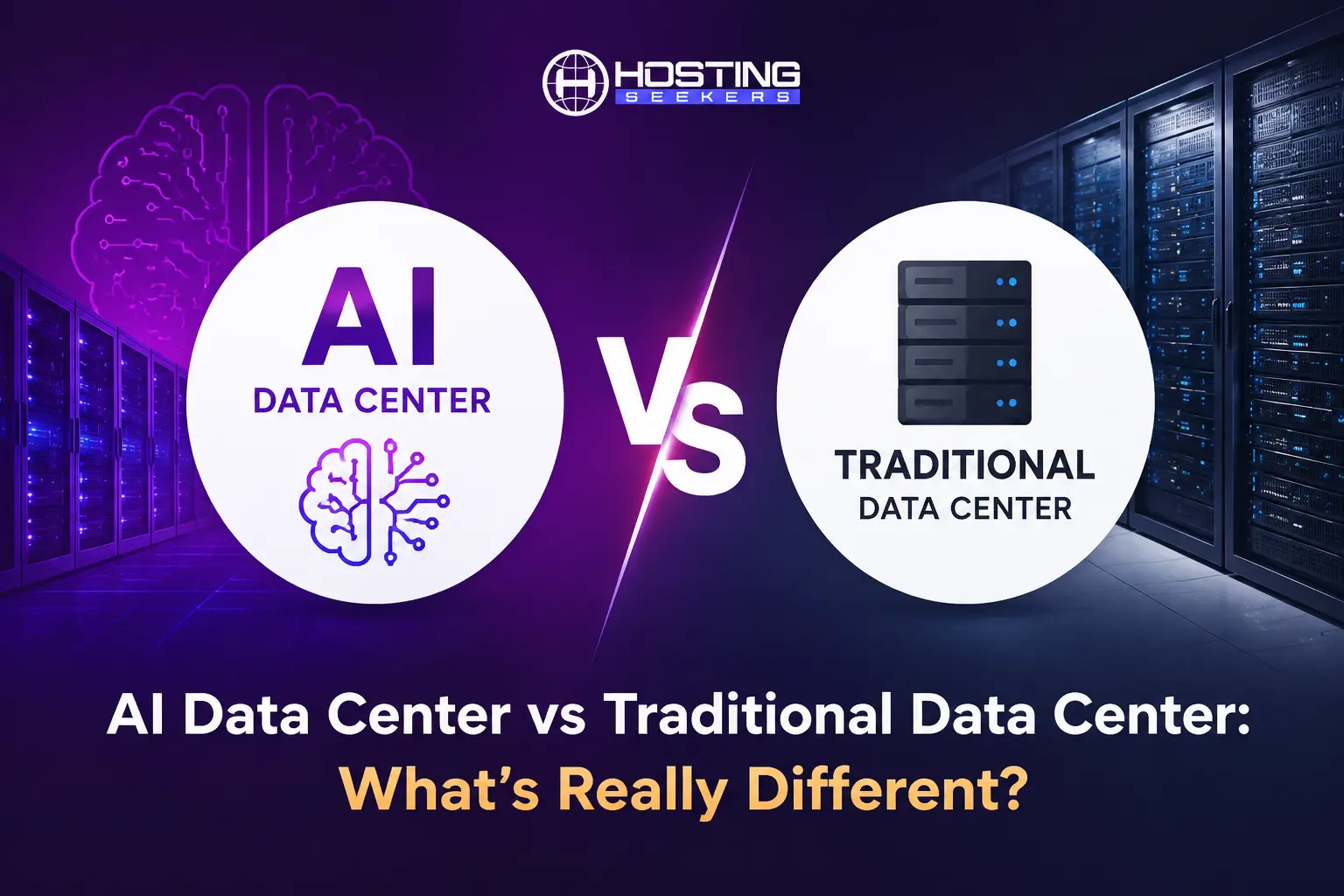
AI Data Center vs Traditional Data Center: What’s Really Different?
IT Updated on : September 14, 2026Artificial intelligence is transforming companies’ approach to data processing, training machine learning models, and deploying intelligent applications. With growing AI adoption, traditional data centers are often unable to meet the extreme computing, networking, and power requirements of modern AI workloads.
While traditional data centers remain essential for hosting websites, business applications, databases, and cloud services, AI data centers are purpose-built to handle massive computational demands.
Here, we will discuss “AI Data Center vs Traditional Data Center”, to understand the difference better.
What Is a Traditional Data Center?
A traditional data center has a collection of servers, storage, and networking infrastructure for IT workloads like web hosting or cloud storage. Key priorities are reliability and uptime, steady performance for moderate workloads, and cost efficiency. The power density for the rack is controlled by air cooling and precision air conditioning with a range of 5 kW to 15 kW per rack. These can also perform simple AI functions, like chatbots and analytics.
What Is an AI Data Center?
An AI data center is specifically designed for compute-intensive AI and machine learning tasks, such as training language models and processing deep learning algorithms. Unlike traditional data centers, AI data centers feature high-density GPU clusters, fast networking, advanced cooling systems, and substantial power capacity, often referred to as AI factories due to their focus on actively processing information to produce intelligence.
Market context: The global AI data center market was valued at $147.3 billion in 2025 and is projected to grow at a CAGR of 23.9% through 2026 – 2033, according to Grand View Research. Morgan Stanley estimates the industry will spend approximately $3 trillion on building AI data centers between 2025 and 2029.
AI Data Center vs Traditional Data Center: Core Differences
The table below summarizes the most significant differences across key infrastructure dimensions.
| Category | Traditional Data Center | AI Data Center |
|---|---|---|
| Primary Processor | General-purpose CPUs | GPUs, TPUs, and AI accelerators |
| Rack Power Density | 5–15 kW per rack | 30–120+ kW per rack (expanding to 300–600+ kW per rack) |
| Cooling Method | Air cooling (CRAC/CRAH units) | Liquid cooling, direct-to-chip, immersion cooling |
| PUE (Average) | 1.5–1.8 (air-cooled) | 1.02–1.3 (liquid-cooled) |
| Networking | Standard Ethernet (1–10 Gbps), modernized to 25–100 Gbps | InfiniBand, 800 Gbps Ethernet |
| Storage | HDDs, SSDs, object/block storage | NVMe SSDs, parallel file systems, HBM |
| Primary Workloads | Web hosting, email, ERP, databases | LLM training, inference, deep learning, NLP |
| Power Consumption | Lower, stable loads | High and sustained (GPUs at 700–1,200 W each) |
| Scalability Focus | Horizontal scaling across servers | Parallel scaling across thousands of GPUs |
| Build Cost | Lower CapEx per MW | Significantly higher CapEx per MW |
Architecture Differences Between AI and Traditional Data Centers
1. Compute Infrastructure
The biggest difference lies in computing hardware.
Traditional data centers rely heavily on CPU-based servers because business applications often require sequential processing and balanced performance.
AI data centers use:
- GPUs
- AI accelerators
- High-performance CPUs
- Dense compute clusters
AI workloads require thousands of calculations to be processed simultaneously, making GPU acceleration essential.
Traditional Data Center Example
A business running:
- Web servers
- CRM software
- Accounting applications
- Email systems
can efficiently operate using CPU-based infrastructure.
AI Data Center Example
Training a large language model requires:
- Multiple GPU servers
- High-speed interconnects
- Parallel processing capabilities
- which traditional infrastructure cannot efficiently deliver.
2. Power Requirements
AI systems consume significantly more power than traditional workloads.
Training machine learning models can require hundreds or thousands of GPUs operating continuously for extended periods.
As a result, AI data centers require:
- Higher power density
- Advanced power distribution systems
- Redundant energy infrastructure
- Sophisticated power monitoring
Traditional data centers generally have lower rack-level power requirements because most enterprise applications are less computationally intensive.
3. Cooling Infrastructure
Heat generation is one of the biggest challenges in AI environments.
High-density GPU clusters produce substantially more heat than standard servers.
AI Data Center Cooling
Common cooling methods include:
- Direct-to-chip liquid cooling
- Immersion cooling
- Hybrid cooling systems
- Rear-door heat exchangers
Traditional Data Center Cooling
Most traditional facilities use:
- Computer room air conditioning (CRAC)
- Computer room air handlers (CRAH)
- Hot aisle/cold aisle containment
These methods are typically sufficient for conventional workloads.
4. Networking Requirements
AI workloads move enormous amounts of data between servers, storage systems, and accelerators.
AI data centers require:
- Ultra-low latency networks
- High-throughput interconnects
- Fast east-west traffic handling
- Distributed training support
Traditional data centers generally focus on:
- Application delivery
- Internet connectivity
- Internal business communications
As a result, networking demands are usually lower.
5. Storage Architecture
AI projects generate and consume massive datasets.
AI storage systems prioritize:
- High throughput
- Parallel access
- Fast data retrieval
- Scalable object storage
Traditional data centers often focus on:
- Transaction processing
- File storage
- Database performance
- Backup and disaster recovery
Why AI Data Centers Require GPUs?
Artificial intelligence algorithms perform millions or billions of mathematical operations simultaneously. GPUs are designed for parallel computing, allowing them to process many tasks concurrently.
Benefits of GPU-powered AI infrastructure include:
- Faster model training
- Improved inference performance
- Better scalability
- Reduced processing time
This is why AI-focused facilities invest heavily in GPU servers and specialized accelerators rather than relying solely on CPUs.
Which Workloads Belong in Each Type?
Matching workloads to the right infrastructure type is important for both performance and cost management.
Traditional Data Center Workloads
- Web hosting and web servers
- Enterprise applications (ERP, CRM, HR software)
- Email and collaboration platforms
- Relational databases and data warehousing
- Cloud storage and backup
Basic AI inference tasks, such as simple recommendation engines or lightweight chatbots
AI Data Center Workloads
- Training large language models (LLMs) and foundation models
- Deep learning and neural network training
- Natural language processing (NLP) at scale
- Computer vision and image recognition pipelines
- High-volume AI inference (serving LLMs, generative AI, real-time recommendations)
- Agentic AI systems and multi-step autonomous workflows
- Scientific computing and high-performance computing (HPC) research
It is worth noting that not every organization needs a dedicated AI data center. Cloud providers including AWS, Google Cloud, and Microsoft Azure offer GPU-based AI compute as on-demand services, giving organizations of all sizes access to AI infrastructure without building their own.
Why Are AI Data Centers Growing So Fast?
AI data centers represent one of the fastest-growing segments in the infrastructure industry. Several converging factors are driving this growth:
1. Generative AI adoption: Microsoft reported that global adoption of generative AI tools reached 17.8% of the world’s population in early 2026, up from 15.1% in the first half of 2025. Each user interaction with an AI service triggers inference compute, driving sustained demand for AI infrastructure.
2. Model scale: AI models continue to grow in size and complexity. Training frontier models requires thousands of GPUs running for weeks or months, consuming enormous amounts of compute and energy.
3. Enterprise AI deployment: According to a 2024 IBM IBV report, 43% of C-level technology executives said their concerns about technology infrastructure had increased because of generative AI, reflecting growing enterprise focus on AI-ready infrastructure.
4. Sovereign AI: Governments worldwide are investing in national AI compute infrastructure. In October 2025, Google announced a $15 billion investment to build India’s first AI hub in Visakhapatnam. Microsoft has pledged $30 billion in the UK’s AI sector.
AI Data Center vs Traditional Data Center: Which Do You Need?
The right answer depends entirely on the workloads you are running and the scale at which you are running them.
| Choose a Traditional Data Center if… | Choose an AI Data Center if… |
|---|---|
| You run standard web, application, or database workloads. | You are training or fine-tuning large AI models. |
| Your compute loads are moderate and variable. | You are running large-scale AI inference at high volume. |
| You need cost-efficient general-purpose hosting. | Your workloads require GPU clusters or AI accelerators. |
| Your workloads do not require parallel processing at scale. | You work with large unstructured datasets such as images, videos, and text. |
| You support SaaS applications, CRM, ERP, or collaboration tools. | You are building or deploying LLMs, computer vision, or generative AI systems. |
Conclusion
AI data centers and traditional data centers serve different but increasingly interconnected roles in modern computing. Traditional facilities remain the foundation for enterprise IT, web hosting, and business applications, while AI data centers provide the specialized infrastructure required for machine learning, generative AI, and high-performance computing.
As artificial intelligence continues to drive innovation, organizations must evaluate their workload requirements, scalability goals, power availability, budget constraints, and hosting and compute strategy when choosing between traditional and AI-focused infrastructure. Understanding where each type of infrastructure fits is a must whether you are hosting a website, scaling a SaaS product, or building an AI-powered service.
Frequently Asked Questions
Q1. What is the main difference between an AI data center and a traditional data center?
Ans. An AI data center is optimized for machine learning, deep learning, and GPU-intensive workloads, while a traditional data center is designed for general business applications, databases, and web hosting.
Q2. Why do AI data centers use GPUs?
Ans. GPUs can perform thousands of calculations simultaneously, making them ideal for training and running AI models that require massive parallel processing.
Q3. Are AI data centers more expensive?
Ans. Yes, AI data centers typically require specialized hardware, advanced cooling systems, and higher power capacity, resulting in greater infrastructure costs.
Q4. Can a traditional data center be upgraded for AI workloads?
Ans. Yes, organizations can add GPU servers, faster networking, and improved cooling systems to support AI applications, though scalability may be limited compared to purpose-built AI facilities.
Q5. Do AI data centers consume more electricity?
Ans. Yes. AI workloads demand significantly more computational power, which increases energy consumption and cooling requirements.

manvinder Singh
https://www.hostingseekers.com
Manvinder Singh is the Founder and CEO of HostingSeekers, an award-winning go-to-directory for all things hosting. Our team conducts extensive research to filter the top solution providers, enabling visitors to effortlessly pick the one that perfectly suits their needs. We are one of the fastest growing web directories, with 500+ global companies currently listed on our platform.