How To Buy A Premium Domain & Give Your Business A Memorable Identity
Domains Updated on : November 4, 2026In the era of the digital landscape, where businesses and individuals converge to share ideas, services, and products, the significance of a domain name cannot be overstated. As you embark on the journey of establishing your online presence, you need a good domain name to leave a positive impact on your target audience.
A premium domain offers possibilities beyond the ordinary; as per recent statistics, 47.8 % of global websites utilized premium top-level domains.
In this article, we will go through how to buy a premium domain and boost your business.
Table of Contents
- What is a Premium Domain Name?
- Premium Domain Names – What Makes A Domain Premium
- How Do Premium Domains Work
- Why Should You Consider Buying Premium Domain Names For Your Business
- How To Buy A Premium Domain – The Process
- Best Place To Buy Premium Domains for Sale
- Conclusion
- Frequently Asked Questions
What is a Premium Domain Name?
A premium domain is a short, memorable, or keyword-rich domain name that sells far more than a standard registration. There is no official definition, and the label means two different things depending on who sets the price. That distinction decides what you pay today and what you pay every year afterward, so understand it before you start shopping.
A registry premium domain is a name that the registry (the organization that runs the extension, such as Verisign for .com) has never released at the standard price. It is unregistered, and it shows up in registrar search results with a premium price tag. The registry sets the wholesale price, and registrars add their own markup, so pricing is similar across registrars and worth comparing before you pay. An aftermarket domain is already registered by someone else, and the current owner decides what it costs. Prices are set by negotiation and demand rather than a fixed registry tier.
| Registry premium | Aftermarket premium | |
|---|---|---|
| Already registered? | Usually, no | Yes |
| Who sets the price? | The registry sets the wholesale price; registrars add a markup | The current owner |
| Typical price | Roughly $20 to several thousand dollars per year. | Around a thousand dollars to six figures and beyond, as a one-time purchase. |
| Renewal price | Often premium, every year | Usually standard, unless the name also carries a registry premium tier |
| Can you negotiate? | Normally no | Often yes |
| Where you buy | Any registrar at checkout | Marketplace, broker, or the owner directly |
Because the renewal rule is the one buyers most often get wrong, treat it as a verify-every-time item. An aftermarket domain can itself carry a registry premium tier, in which case premium renewal pricing can continue after you buy it. Always read the renewal price at checkout instead of assuming it will drop to standard.
Premium domains tend to share a few traits. They are short, usually one or two words. They are easy to spell and say aloud. They are often a common word, a category keyword, or a strong brandable name with the .com extension. And they have buyer demand behind them: when more than one party wants the same name, its price climbs.
Premium Domain Names – What Makes A Domain Premium
There are no set rules that define any domain as ‘premium’. Instead, it is decided on the domain registry. Whether a domain will be ‘premium’ depends on the owner and the price potential buyers are ready to pay. However, there are several traits that set premium domain names apart from standard domains. These qualities can aid purchasers in determining if the price they are willing to pay is reasonable.
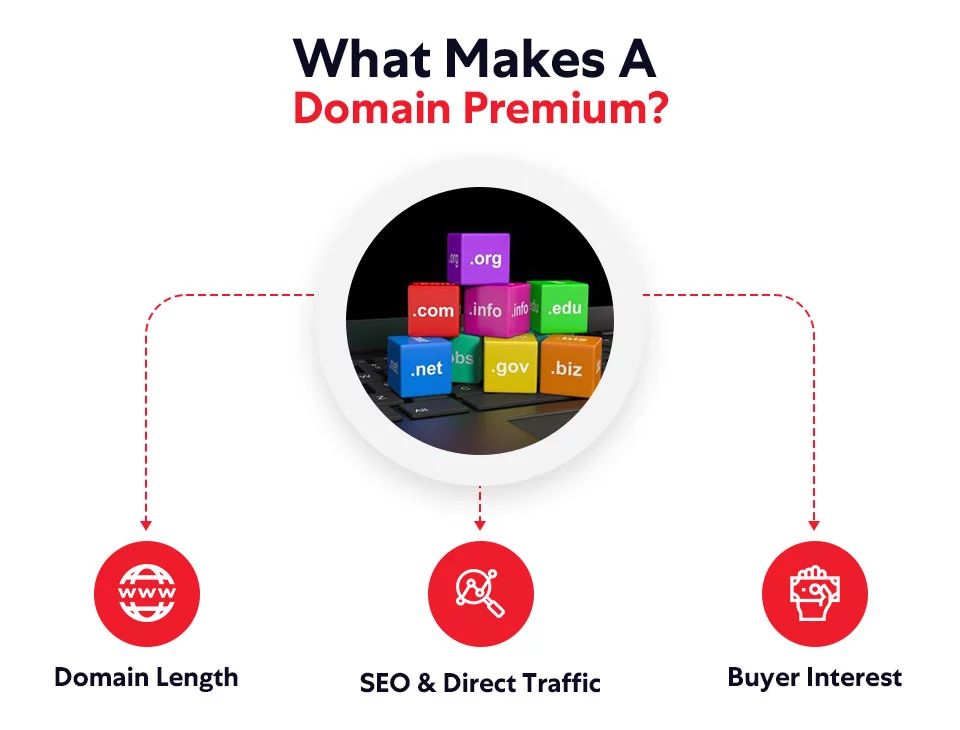
1. Domain Length
The length of premium domains for sale tends to be short. It is said that the shorter, the better. This length comprises just two or 3-letters, as companies use these for abbreviations. While some of the available premium domain names may be lengthy, too, good domains barely contain more than a couple of words.
2. SEO & Direct Traffic
Often most premium domains match the words people search for on the internet. It can also comprise one or more keywords. Domain names with exact matches are usually priced higher. Further, a premium domain with keywords brings additional organic traffic to a site.
3. Buyer Interest
A domain name may not appear appealing at first glance. However, if it gets high bids when auctioned, it’s easier to turn into a premium domain. Usually, this is the case when a newly launched firm wants to buy an existing domain that matches its name or any product or service. Many such firms use a domain broker to negotiate with the current owner. So, if the buyer is willing to pay more for an existing domain, its chances of becoming a premium domain increase.
How Do Premium Domains Work
Premium domains operate within a unique framework that sets them apart in the digital landscape. Here‘s an overview of how they function:
1. Selection and Acquisition: Premium domains are carefully curated based on their inherent value, often composed of short, memorable, and meaningful words or phrases. These domains are either selected by domain registration providers or individuals who foresee their potential marketability.
2. Higher Price Point: One defining aspect of available premium domains is their relatively higher price tag compared to regular domain names. This is primarily due to their perceived value, driven by factors such as brandability, keyword relevance, and market demand.
3. Investment and Branding: Premium domains are seen as investments, akin to acquiring valuable real estate in the digital world. They are often chosen to bolster a brand’s online presence, lending an air of professionalism, trustworthiness, and memorability to the associated website.
Note: You will need to renew your domain registration every year. This means there are domains that have either expired or tend to expire. You can get them renewed by domain registrars at a regular cost along with the benefit of a backorder service fee.
Why Should You Consider Buying Premium Domain Names For Your Business
As per recent stats, there are around 200 million active websites on the internet. Also, globally, 71% of businesses have a website in 2023.
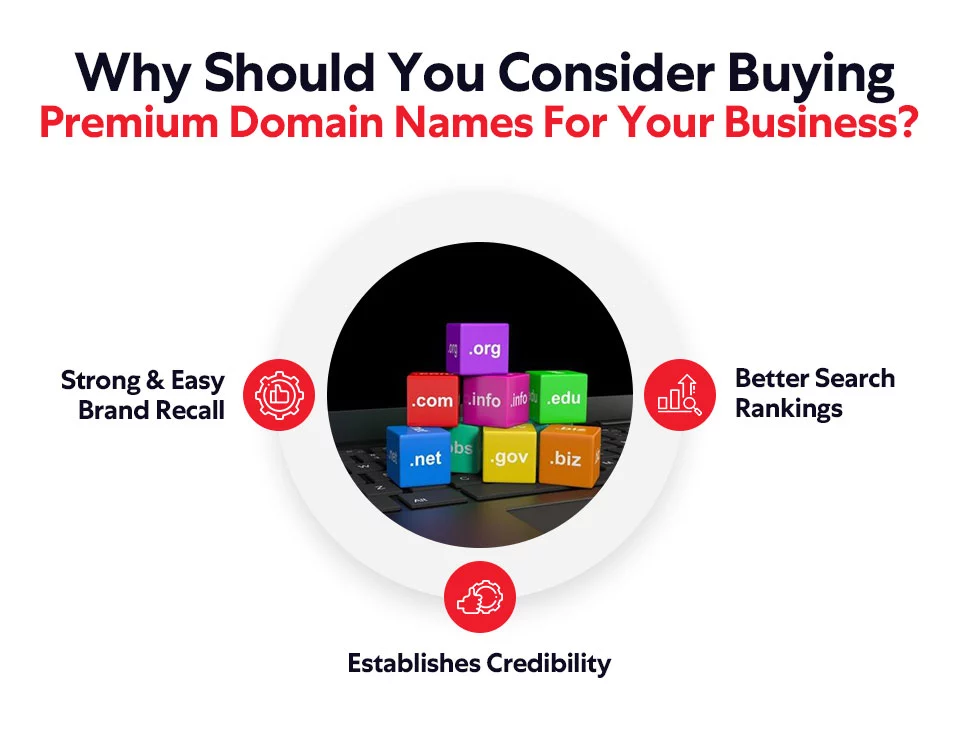
1. Strong & Easy Brand Recall
The foremost target of marketers is to get their brand’s name stuck in the mind of their prospective customers. Having a domain name that is short, catchy, and to the point makes it easy for potential customers to remember.
For instance, if you are selling web development services, a domain name such as webdevelopment.com is more accessible to recall than something like bestwebdevelopmentservices.com. Strong brand recall distinguishes you from your competitors and increases search traffic to your site.
2. Better Search Rankings
Premium domains are an excellent way to improve your search engine rankings. It is an investment that will impact your search engine ranking positively. How? This is because a premium name is generally short and keyword-specific, making it easily viewable by the search engines against any relevant search query.
3. Establishes Credibility
Since premium names seem more prestigious, potential customers are more likely to visit your site and avail themselves of your products or services. It is similar to visiting a well-designed shop in the market or a worn-out store.
Also, your keyword-specific premium domain will immediately paint a picture in your prospects’ minds. And they will visit your website whenever they need relevant services or products.
How To Buy A Premium Domain – The Process
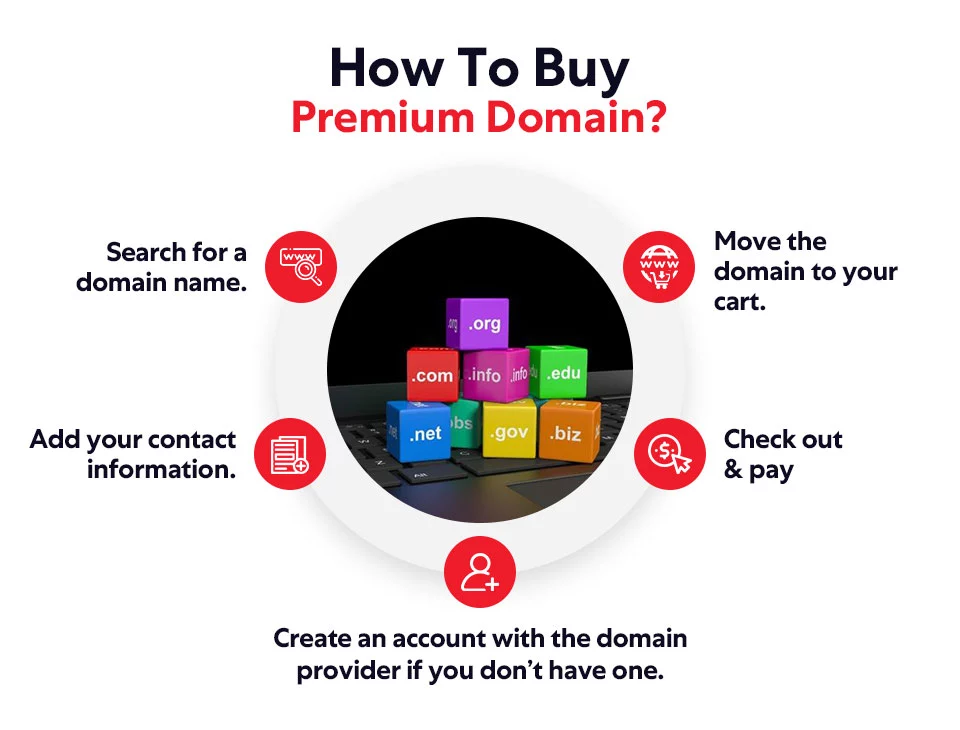
Step 1: Search for a domain name
Step 2: Add the domain name to your cart
Step 3: Add your contact information
Step 4: Check out and pay
Step 5: Create an account with the domain provider
Step 1: Search for a Domain Name
To buy premium domain names, search for a domain name that aligns with your business or brand. You can use domain search tools like GoDaddy and others to find the premium domain.
Step 2: Add Domain Name to your Cart
After finalizing the ideal premium domain, the next step is to add it to your cart. This is the first step towards your business ownership, resulting in buying the domain.
Step 3: Add your Contact Information
Add your contact information during the seamless checkout process. This helps in accessible communication with the domain hosting provider if you face any difficulty.
Step 4: Check Out and Pay
The next step is to make a secure check; all you need to do is pay the amount and complete the payment process for the premium domain. These steps help in finalizing the transaction.
Step 5: Create an Account with the Domain Provider
If you don’t have an account with the domain provider, sign up. An account helps you effectively manage your premium domain and access associated services.
Step-by-Step: How to Buy an Aftermarket Domain That Is Already Taken
If you want to buy a domain that is already registered, follow these seven steps to find the owner, negotiate a price, complete the purchase, and secure ownership.
Step 1: Check Domain Ownership
Start by confirming that the domain is already registered and identifying its current owner. Most WHOIS data is now hidden for privacy reasons, so begin with ICANN’s official lookup tool (lookup.icann.org), which uses the newer RDAP protocol. It shows the registrar, registration and expiry dates, and domain status even when the owner’s contact details are redacted. If the owner uses domain privacy protection, contact them through the registrar’s contact form or the marketplace’s “Make an Offer” option.
Step 2: Set Your Budget
Decide how much you are willing to pay before contacting the seller. Research comparable domain sales and consider the domain’s value to your business. Set a maximum budget and avoid exceeding it during negotiations.
Step 3: Perform Domain Due Diligence
Check the domain history before making an offer. Look for previous spam activity, search engine penalties, trademark conflicts, backlink quality, and ownership history. These factors can affect the domain’s value and future usability.
Step 4: Make an Offer and Negotiate
Contact the owner with a short, professional offer. Start below your maximum budget to leave room for negotiation. Mention the domain name, your proposed price, and your preference for using an escrow service. Avoid sharing unnecessary details about your business or how urgently you need the domain.
Step 5: Agree on Terms and Use Escrow
Once you agree on a price, confirm the payment and transfer terms in writing. Use a trusted escrow service such as Escrow.com to protect both parties. The buyer deposits the payment with the escrow provider, which releases the funds after the agreed transfer conditions are met.
Escrow.com fees depend on the transaction amount. Check out its fee calculator to estimate the cost before proceeding. The buyer usually pays the fee, but this can be negotiated.
Step 6: Complete the Domain Transfer
After the payment is secured in escrow, the seller can either push the domain into your account at the same registrar or provide an authorization (EPP) code for transferring it to another registrar.
Keep ICANN’s 60-day transfer restrictions in mind. A domain may not be eligible for transfer within 60 days of initial registration or certain changes to registrant details. Confirm these restrictions with the seller before making payment.
Step 7: Verify Ownership and Secure the Domain
Once the transfer is complete, confirm that the domain is registered under your details. Then take these security measures:
- Enable the registrar lock to prevent unauthorized transfers.
- Turn on two-factor authentication for your registrar account.
- Enable automatic domain renewal.
- Verify the registrant information and domain expiration date.
Due Diligence Before You Buy
A premium domain is only as valuable as its history. Spend an hour on checks before you pay, because a bad domain is expensive to fix after the fact.
Start with the Wayback Machine. Look at what the domain hosted in the past. Adult content, pharmaceutical spam, link farms, or a long run of unrelated sites are all warning signs.
Then search Google for the exact domain in quotation marks and run a site: search to see whether Google has pages indexed. A domain with no indexed pages and a history of spam may carry a penalty you will inherit. Also check backlinks in a tool such as Ahrefs or Semrush, since a clean, relevant link profile adds value while a toxic one is a liability.
Next, check for blacklists. Run the domain through spam and malware blocklist checkers and send a test email from it once it is yours to make sure it is not already flagged for sending spam. Then run a trademark check. Search the USPTO database and the WIPO Global Brand Database for the name or anything confusingly similar.
Owning a domain does not give you the right to use a name that someone else has trademarked, and trademark owners can use the UDRP process to take domains back. If the name looks close to an existing brand, speak to a trademark attorney before you buy. Finally, verify the seller. Make sure the person selling is the person who controls the domain, which brings us to scams.
Scams and Red Flags
Domain buying scams exploit the fact that large sums change hands over the internet between strangers. Most of them fall into a few patterns, and all of them are avoidable if you follow the process above.
The most common is the fake domain seller: someone who lists or pitches a domain they do not control. The fix is to ask them to prove control, for example by placing a short string you provide as a DNS TXT record on the domain or briefly changing a record, then verify it yourself.
A second pattern is the fake escrow site, a look-alike of a legitimate escrow service built to collect your payment. Always type the escrow company’s address yourself instead of following a link the seller sends, and create the transaction from your own account.
A third pattern is the hijacked domain: one stolen from its real owner and sold quickly at a discount. An unusually low price, urgency, and a seller who pushes you toward irreversible payment all point to this one.
Treat these other red flags as stop signs:
- A seller who insists on wire transfer, cryptocurrency, gift cards, or payment outside escrow.
- Anyone who pressures you with a short deadline or claims several other buyers are about to purchase.
- A seller who will not use a recognized escrow service.
- Inconsistent ownership details between the WHOIS or RDAP record, the email you are talking to, and the registrar.
- An unsolicited message offering a domain you never asked about that happens to match your brand.
If something feels off, walk away, because there is nearly always another good name.
Best Place To Buy Premium Domains for Sale
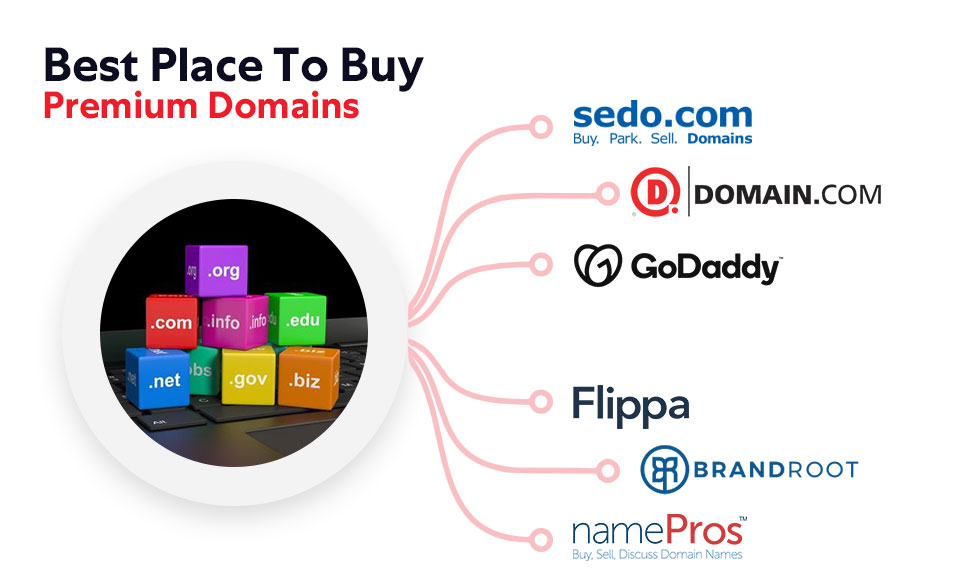
There are several good domain marketplaces where you can find your preferred cheap premium domain names. The top ones are discussed below.
1. Domain.com
The best domain registrar on the market today, Domain.com helps you easily find cheap premium domains for sale. This simple and fast domain search tool offers top-level domains (TLDs) and even discounted domain names at very competitive pricing. Simply visit the website and choose the “premium domains” option from the drop-down menu.
Also, the user-friendly domain management section is another noticeable characteristic of domain.com. From here, you can transfer your domain to any hosting provider & can even build a website.
2. SEDO
One of the biggest domain marketplaces in the world, Sedo offers a reliable platform for domain owners to exhibit their premium domains for sale. The best thing about SEDO is that you can conduct your domain search based on the keywords you are targeting.
On SEDO, you can find four types of domain listings:
- Negotiable
- Buy Now
- Expiring domain auctions
- Marketplace auctions
Plus, SEDO also offers domain brokers, in case you want a professional to negotiate on your behalf for a premium domain.
3. GoDaddy
GoDaddy is the world’s largest domain registrar with millions of domains listed and also sells premium domains. It is a one-stop solution for all your domain-related needs and offers services like domain finder, domain brokers, domain name generator, etc. It also has a marketplace where you can find thousands of GoDaddy domain names.
4. Flippa
Flippa is another of the biggest domain marketplaces where domain owners list their domains for sale, most of which are premium domain names. Most of these domains are available for direct purchase or auction.
You can ‘watch’ the premium domain for sale you are willing to buy and ‘follow’ auctions to stay on top of bidding. If you want to buy cheap premium domains, you can simply bid on it. Flippa also offers broker services just like SEDO.
5. BrandRoot
Brandroot is a well-known premium domain name generator. The platform generates thousands of top-shelf business names that are available. Brandroot hosts more than 22000 .com names that are attractive and brandable.
All you need to do is type in a couple of keywords relevant to your niche, choose from the results and check out.
6. Namepros
Namepros is a leading online community to buy premium domain names. However, it is not a standard domain registrar service. Besides, you can also share and seek information about building businesses, buying and investing in domain names, etc.
Namepros has a dedicated domain section where premium domains are listed as buy now, auction, bargains, and make an offer.
Conclusion
Buying a premium domain is the best investment that can significantly affect your business brand identity. Therefore, by following the above-mentioned steps, you can easily buy a premium domain name. This can quickly develop an online presence that helps you to build robust digital presence.
Frequently Asked Questions
Q1. How to buy a domain for cheap?
Ans. While there’s no surefire way to buy a domain for cheap, you can bid as per your budget in domain auctions on platforms like Flippa, Sedo, and GoDaddy. If your bid gets accepted, you can be the owner of the domain. Also, some types of web hosting providers offer domain names for free as part of their hosting package.
Q2. How do I buy a premium domain name?
Ans. To buy a premium domain name of your interest, simply:
- Search for a domain name.
- Add the domain to your cart.
- Create an account with the domain provider or sign in to your existing account.
- Add your contact information.
- Check out and pay.
The process is the same as that of buying a regular domain.
Q3. Does GoDaddy own premium domains?
Ans. Yes, GoDaddy offers both ordinary and premium domains. You can either buy them directly or bid in the auctions.
Q4. Is it worth buying an expensive domain?
Ans. Premium domains are expensive for reasons like popularity and preference. Such domains can get your business more visibility and traffic while increasing your brand credibility. So, if you are trying to grow your business, you should consider buying an expensive domain.
Q5. What is the most reliable domain?
Ans. The most reliable domain is .com followed by .co as the second. People tend to assume that any URL ends with .com 3.8 times more than any other domain extension.
Q6. What is domain escrow, and is it safe?
Ans. Domain escrow is a neutral third party that holds your payment until the domain has been transferred to you. It is the safest way to buy an aftermarket domain, provided you start the transaction yourself on the escrow company’s real website.
Q7. Why are premium domains so expensive?
Ans. Price reflects scarcity and demand: short, memorable, keyword-rich names on .com are limited, and owners price them on what a business would pay for the brand value. Registry premiums are priced by the registry, and aftermarket names by the owner.
Q8. Are premium domain renewals more expensive?
Ans. Registry premium domains often renew at a premium rate every year. Aftermarket domains usually renew at the standard rate, unless the name also carries a registry premium tier, so confirm the renewal price before you buy.
Q9. How do I find out who owns a domain?
Ans. Use a WHOIS lookup. Many owners use privacy protection, in which case you can contact them through the registrar relay, the marketplace listing, or a broker.
Q10. Can I negotiate the price of a premium domain?
Ans. Yes, for aftermarket domains. Make-offer listings and direct deals are negotiable, while registry premium prices are fixed. Do your due diligence first, open well below your ceiling, and be ready to walk away.

manvinder Singh
https://www.hostingseekers.com
Manvinder Singh is the Founder and CEO of HostingSeekers, an award-winning go-to-directory for all things hosting. Our team conducts extensive research to filter the top solution providers, enabling visitors to effortlessly pick the one that perfectly suits their needs. We are one of the fastest growing web directories, with 500+ global companies currently listed on our platform.