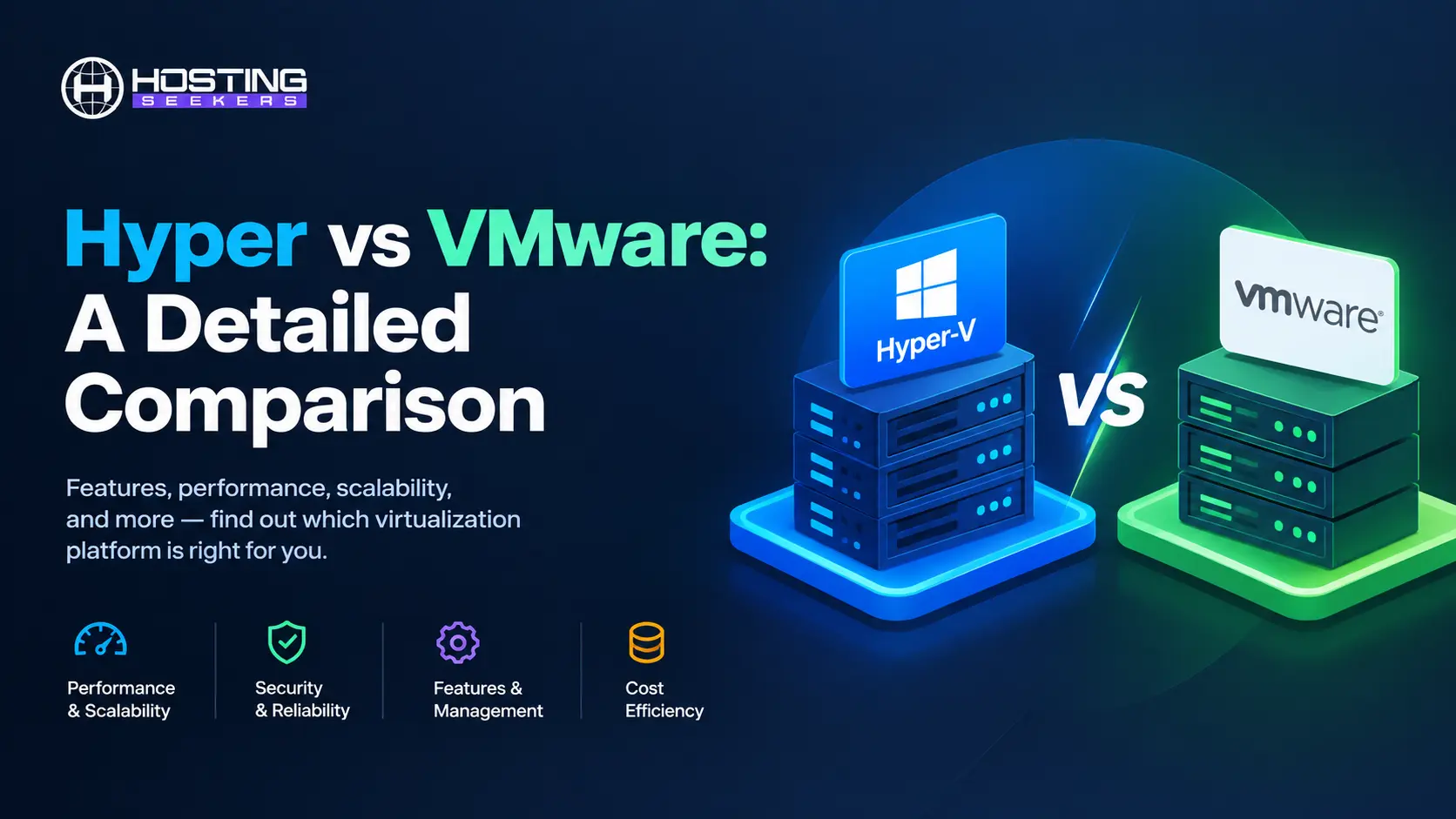
Hyper vs VMware: A Detailed Comparison
Comparison Published on : September 18, 2026Choosing a hypervisor used to be a fairly settled question for most IT teams: VMware for anyone serious about enterprise virtualization, Hyper-V for shops already committed to the Microsoft ecosystem. That calculus has shifted. Since Broadcom’s acquisition of VMware closed in late 2023, the company has eliminated perpetual licensing, folded its product line into subscription bundles, and pushed costs up sharply for a large share of its customer base.
Hyper-V, meanwhile, has quietly become a much more capable platform, with Windows Server 2025 bringing some of the biggest scalability gains the product has seen in years. This piece walks through how the two compare today, from cost and licensing through to performance, security, and day-to-day management, so you can weigh which one actually fits your environment.
Hyper-V vs VMware at a Glance
| Comparison Factor | Microsoft Hyper-V Hyper-V |
VMware (vSphere / VCF) VMware |
|---|---|---|
| Licensing Model | Per-core Windows Server license (Standard/Datacenter), with no separate hypervisor fee. |
Subscription-only since late 2023, sold as vSphere Foundation (VVF) or VMware Cloud Foundation (VCF) bundles. |
| Typical Starting Cost | Windows Server 2025 Standard around $1,176 and Datacenter around $6,771 per 16-core pack, plus CALs. |
VVF around $135 per core/year and VCF around $350 per core/year on list pricing, with a 16-core-per-CPU and 72-core order minimum. |
| Max VM Scale (Per Host) | Generation 2 VMs support up to 2,048 vCPUs and 240 TB memory. Hosts can scale to 4 PB memory and 2,048 logical processors. |
vSphere 8 supports a single VM with up to 768 vCPUs and roughly 24 TB of memory, with host limits around 960 logical processors. |
| Built-in Networking & Storage | Basic virtual switching is available. Software-defined networking and storage require Azure Stack HCI/Azure Local or third-party tools. |
NSX for software-defined networking and vSAN for software-defined storage are included in VCF bundles. |
| Management Tooling | Hyper-V Manager, PowerShell, Windows Admin Center, and System Center VMM (paid, separate). |
vCenter Server, vSphere Client, and Aria Suite (bundled in VCF). |
| Best Fit | Organizations already standardized on Windows Server, cost-conscious businesses, and mid-size virtualization environments. |
Large, complex, or highly virtualized environments already invested in the VMware ecosystem. |
VMware Pricing After Broadcom
Broadcom retired all VMware perpetual licenses in December 2023 and moved the entire portfolio to subscription-only bundles. Customers no longer buy the virtualization layer on its own; they choose between vSphere Foundation (VVF), the lighter bundle for compute-only needs, and VMware Cloud Foundation (VCF), the full software-defined data center stack that folds in vSAN, NSX, and the Aria management suite whether or not those components are actually used.
List pricing for VCF runs around $350 per core per year, roughly two-and-a-half times VVF’s list rate of around $135 to $140 though few customers pay list: three-year commitments typically shave 18 to 28 percent off, five-year terms more, and negotiated enterprise deals often land 30 to 55 percent below list. Licensing is metered per physical core with a 16-core-per-CPU floor, and since April 2025 Broadcom has also enforced a 72-core minimum order size, which can push small deployments into paying for capacity they don’t have. Entry-level editions aimed at smaller shops for the old Essentials and Essentials Plus kits have been discontinued, and Broadcom now charges a 20 percent penalty on late subscription renewals with no grace period.
On top of the pricing changes, Broadcom also cut the partner program down to a small number of top-tier “Pinnacle” and “Premier” resellers and moved cloud-provider agreements to an invite-only model, adding procurement friction for mid-market customers who relied on local VMware partners. Reported renewal increases of two to twelve times the prior contract aren’t unusual.
Hyper-V Pricing and Licensing
Hyper-V’s cost picture is more familiar. The hypervisor role itself doesn’t carry a separate license fee it’s bundled into Windows Server, so what you’re really paying for is the Windows Server license you’d likely need anyway. Windows Server 2025 is sold per physical core with a 16-core minimum per server, in Standard and Datacenter editions.
List pricing sits around $1,176 for a 16-core Standard pack and roughly $6,771 for the same core count in Datacenter, a gap that’s easy to justify once you’re running more than about a dozen VMs on a single host, since Datacenter grants unlimited VM rights on that server while Standard is capped at two.
CALs are billed separately on top of either edition, or Microsoft also offers pay-as-you-go, per-core monthly billing through Azure Arc for organizations that want to avoid upfront licensing altogether. One thing worth flagging: the old free, standalone Hyper-V Server product a stripped-down, GUI-less SKU that let you run the hypervisor with no Windows Server license at all was discontinued after its 2019 release, so there’s no truly cost-free path to Hyper-V anymore. Even so, for shops that already budget for Windows Server, Hyper-V’s marginal cost to add virtualization is close to zero, a meaningfully different proposition than VMware’s per-core subscription.
Hyper vs VMware: Core Architecture
How ESXi Is Built
VMware’s ESXi is a purpose-built, minimal Type 1 hypervisor with no general-purpose OS underneath historically a smaller attack surface and lighter patching footprint at the host level, paired with vCenter Server as the management layer above it.
How Hyper-V Is Built
Hyper-V is built into the Windows kernel: a “parent partition” running a full instance of Windows Server installs device drivers and manages hardware access, while guest VMs run in isolated child partitions that talk to devices over a virtual bus. This gives Hyper-V tight integration with the rest of the Windows ecosystem, but it also means the underlying host is a full Windows Server instance, with all the patching that implies, even in Server Core.
Hyper vs VMware: Clustering, High Availability, and Live Migration
VMware’s HA, DRS, and vMotion
VMware’s stack is the more mature of the two: vSphere HA restarts VMs automatically on surviving hosts, Distributed Resource Scheduler (DRS) continuously rebalances workloads across the cluster based on live CPU and memory pressure, vMotion moves running VMs between hosts with no downtime, and Fault Tolerance goes a step further by keeping a live shadow VM in lockstep so failover is instantaneous rather than a restart. VMware’s VMFS is also a genuinely clustered filesystem that multiple ESXi hosts can access concurrently with native on-disk locking, so a basic cluster doesn’t require a quorum witness.
Hyper-V’s Failover Clustering and Live Migration
Hyper-V covers the same ground with Failover Clustering for automatic VM restart, Live Migration for zero-downtime VM moves, and Storage Live Migration for moving virtual disks between locations while a VM stays online, plus cluster-aware updating and node draining for patching with minimal disruption. Its load-balancing is comparatively less granular than DRS, redistributing VMs periodically based on cluster health metrics rather than continuously optimizing placement. Hyper-V relies on Cluster Shared Volumes (CSV) layered on top of NTFS or ReFS not a true clustered filesystem, but a redirection layer that coordinates access through a designated owner node and does require a quorum witness for multi-node resiliency.
Hyper vs VMware: Storage and Filesystem
VMware Storage: VMFS, vSAN, and More
VMware’s default is VMFS, purpose-built for concurrent multi-host access, alongside support for NFS, iSCSI, Fibre Channel, and vSAN for hyperconverged deployments; Storage DRS and Storage vMotion add automatic datastore placement and live disk migration on top.
Hyper-V Storage: NTFS, ReFS, and S2D
Hyper-V uses NTFS or ReFS for VM storage. ReFS adds resilience features like block cloning and online repair of data corruption with CSV enabling shared access for clustering, and supports SMB 3.0, iSCSI, and Fibre Channel as connection protocols. For hyperconverged setups, Storage Spaces Direct (S2D) pools local disks across cluster nodes over SMB3, available in Windows Server Datacenter, as Hyper-V’s rough equivalent to vSAN.
Hyper vs VMware: Performance and Scalability
Hyper-V’s Windows Server 2025 Scalability Jump
Windows Server 2025 gave Hyper-V a genuinely large scalability jump. A single Generation 2 VM can now be provisioned with up to 2,048 virtual CPUs and 240 TB of memory, and a host can scale to 4 petabytes of memory and 2,048 logical processors, with GPU partitioning and live migration support for graphics and AI workloads. That per-VM ceiling now actually exceeds VMware’s.
VMware’s vSphere 8 Limits and the DRS Advantage
vSphere 8 caps a single virtual machine at 768 vCPUs and 24 TB of RAM, with host limits around 960 logical processors and 16 TB of memory. In practice, few real workloads approach either platform’s upper bound, or VMware’s advantage isn’t really about raw ceilings anymore it’s DRS’s continuous, automated load balancing across large, heterogeneous clusters, which remains more mature than Hyper-V’s periodic, metrics-based redistribution.
Hyper vs VMware: Security
Hyper-V Security Features
Hyper-V benefits from tight integration with Windows security tooling: Shielded VMs, virtual TPM, and the Host Guardian Service keep VMs encrypted and tamper-resistant so they only run on trusted, attested hosts, while Credential Guard and Device Guard protect host-level credentials and enforce code integrity.
VMware Security Features
VMware’s security model centers on VM Encryption and Encrypted vMotion for data at rest and in transit, UEFI Secure Boot and virtual TPM, role-based access control through vCenter, and, for organizations on VCF, NSX Distributed Firewall for microsegmentation and Carbon Black Workload for behavioral monitoring, together giving VMware a genuinely strong story for controlling east-west traffic inside a data center. Since the Broadcom acquisition, some VMware customers have raised concerns about patch cadence and reduced transparency as the product portfolio and support tiers have been restructured, worth factoring in if predictable security patching is a priority.
Hyper vs VMware: Backup and Disaster Recovery
Change Tracking: CBT vs RCT
Both platforms are well supported by the major backup vendors Veeam, Nakivo, Altaro, and others so a hypervisor migration typically doesn’t force a backup-stack rebuild. The real technical difference sits in change tracking: VMware uses Changed Block Tracking (CBT), available since vSphere 4.0, while Hyper-V uses Resilient Change Tracking (RCT), introduced in Windows Server 2016 and refined since. Both let backup software capture only the blocks that changed since the last backup, but RCT is generally considered more resilient to interruptions like storage migrations or snapshot changes, where CBT can occasionally need a manual reset after a hard shutdown or power failure.
Replication and Disaster Recovery Tools
VMware offers vSphere Replication and the more advanced Site Recovery Manager (recently rebranded Live Site Recovery), while Hyper-V provides Hyper-V Replica for asynchronous VM replication and integrates with Azure Site Recovery for cloud-based disaster recovery.
Hyper vs VMware: Management and Administration Experience
Managing VMware
VMware’s vCenter Server remains the more polished single pane of glass for anything beyond a handful of hosts, with mature role-based access control, PowerCLI for scripting, and built-in lifecycle management, with Aria Suite layered on top in VCF deployments for automation and cost visibility.
Managing Hyper-V
Hyper-V is managed through Hyper-V Manager for standalone hosts, Failover Cluster Manager for clustered environments, PowerShell for automation, and increasingly Windows Admin Center as Microsoft’s browser-based hub for both. Larger environments that want VMware-style centralized orchestration typically add System Center Virtual Machine Manager, a separately licensed product rather than something bundled with Windows Server.
Teams moving from VMware to Hyper-V generally find day-to-day VM operations familiar but should expect to spend more time stitching together PowerShell, Windows Admin Center, and SCVMM to replicate what vCenter does natively.
Hyper vs VMware: Support and Ecosystem
VMware’s Ecosystem and Partner Changes
VMware’s ecosystem is still the deeper one, with a large base of third-party tooling built specifically around vSphere APIs, decades of enterprise adoption, and one of the most technically engaged user communities in IT (VMUG). The trade-off is that Broadcom’s changes have made planning harder: the shrunken partner network and less predictable renewal pricing add friction that wasn’t there under the old VMware regime.
Hyper-V’s Ecosystem and Azure Local
Hyper-V’s ecosystem leans on the sheer size of the Windows Server install base and a well-supported, agentless migration path (built into Windows Admin Center) for organizations moving VMs off VMware. Worth knowing if you’re evaluating the broader Microsoft stack: Azure Local (formerly Azure Stack HCI) is Microsoft’s cloud-connected, hyperconverged evolution of Hyper-V it strips out traditional Windows Server roles, bills per-core through an Azure subscription rather than a Windows Server license and adds native Azure Arc management and built-in AKS. It’s a different buying decision from plain Hyper-V, but it’s the platform Microsoft is steering larger, cloud-aligned migrations toward.
Conclusion
The Hyper-V vs VMware decision in 2026 isn’t really about which platform has more features anymore, it’s about which cost and operating model your organization is willing to live with. Broadcom’s subscription overhaul turned VMware from a routine infrastructure expense into a recurring, often unpredictable line item, while Microsoft used the opening to close the technical gap that used to justify VMware’s premium, particularly around clustering and per-VM scale. Neither platform is objectively “better” across the board: VMware still has the deeper ecosystem and the more mature automation for large, heterogeneous environments, and Hyper-V still asks you to assemble PowerShell, Windows Admin Center, and SCVMM to get vCenter-equivalent visibility. The right call comes down to what you’re already running, how exposed you are to VMware’s renewal cycle, and whether the features locked inside VCF’s bundle are ones you actually use or ones you’d be paying for anyway.
Frequently Asked Questions
Q1. Is Hyper-V as good as VMware in 2026?
Ans. For most general-purpose virtualization needs, yes, Windows Server 2025 closed much of the historical gap and now actually exceeds VMware on per-VM scalability limits. VMware still leads on continuous automated load balancing (DRS) across large clusters and on built-in software-defined networking and storage (NSX and vSAN).
Q2. Why are companies moving from VMware to Hyper-V?
Ans. Mostly costs. Broadcom’s shift to subscription-only licensing, the retirement of SMB-friendly editions, core minimums, and steep renewal increases have pushed many mid-size organizations toward platforms where the marginal cost of virtualization is lower, and Hyper-V is one of the more common landing spots given its familiarity and bundling with Windows Server.
Q3. Is Hyper-V free?
Ans. Not in the way it once was. The Hyper-V role itself carries no separate charge, but it only runs inside a licensed Windows Server or Windows Pro/Enterprise to install. The old standalone, no-cost Hyper-V Server product was discontinued after its 2019 release.
Q4. What’s the difference between VMFS and CSVFS?
Ans. VMFS is a true clustered filesystem that multiple ESXi hosts can access concurrently with native locking. Hyper-V’s CSV is a redirection layer on top of NTFS or ReFS rather than a native clustered filesystem, and it needs a quorum witness for multi-node setups that VMFS doesn’t require for basic clustering.
Q5. Can I run VMware VMs on Hyper-V, or vice versa?
Ans. Migrating between the two isn’t a simple lift-and-shift, since disk formats and drivers differ, but Microsoft provides an agentless conversion wizard through Windows Admin Center for moving VMware VMs to Hyper-V, and third-party tools support conversions in both directions.
Q6. Which is better for small businesses?
Ans. Hyper-V is generally the easier sell now that VMware has discontinued its low-cost entry editions and moved everything to per-core subscriptions with 72-core order minimums. A business already running Windows Server gets Hyper-V’s core capability with no separate hypervisor licensing fee.

manvinder Singh
https://www.hostingseekers.com
Manvinder Singh is the Founder and CEO of HostingSeekers, an award-winning go-to-directory for all things hosting. Our team conducts extensive research to filter the top solution providers, enabling visitors to effortlessly pick the one that perfectly suits their needs. We are one of the fastest growing web directories, with 500+ global companies currently listed on our platform.