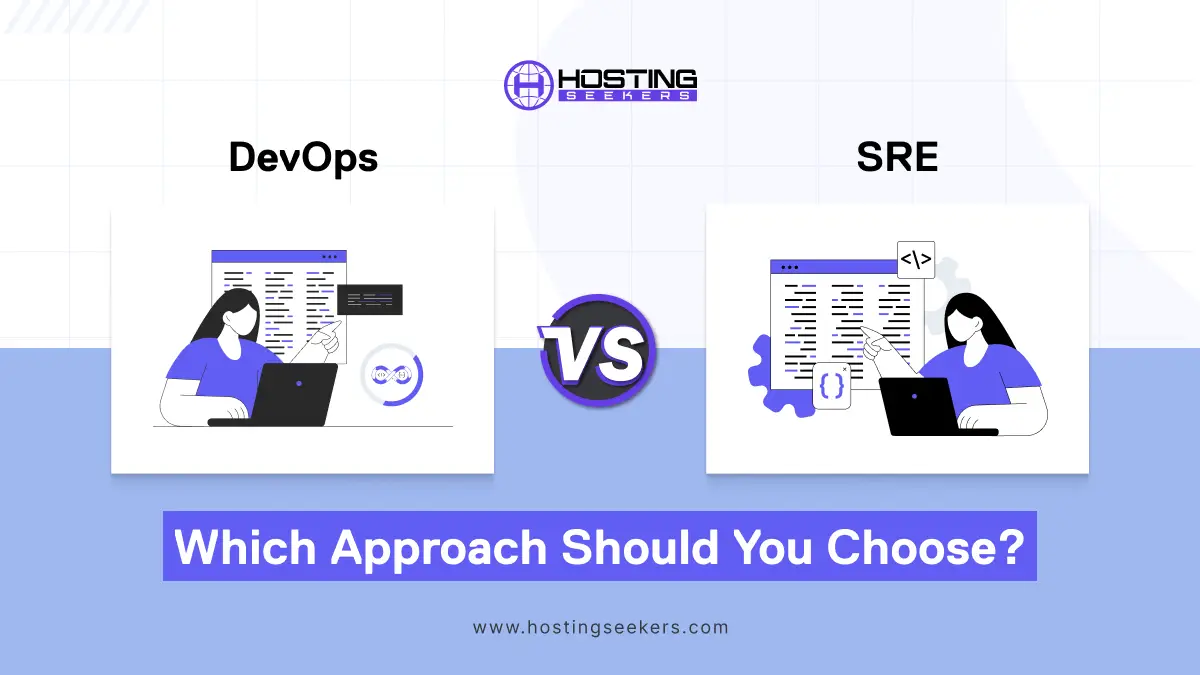
DevOps vs SRE in 2026: Which Approach Should You Choose?
Development Published on : May 27, 2026The DevOps vs SRE debate has gained attention beyond methodology discussions. As AI-assisted deployment is becoming standard, choosing the right engineering model has become crucial from a business perspective. This article helps you decide which model is right for your team, whether DevOps or SRE. Also, it will help decide which hosting and infrastructure setups will benefit more from each.
Quick Answer
DevOps comes with more culture and delivery philosophy, while SRE mainly focuses on reliability. Most businesses in 2026 need both.
What is DevOps in 2026?
DevOps is a way of working that brings your development team and operations team together. Before DevOps, these two groups where often completely separate developers wrote code and then handed it off to operations teams. ” to operations to deal with. That created slow releases, blame games, and a lot of broken deployments.
DevOps fixes this by encouraging everyone to share ownership of the software from writing it to running it in production.
The Core Idea Behind DevOps
Think of DevOps as building a well-oiled factory line for software. Instead of big, risky releases once a month, DevOps teams ship small updates frequently, sometimes dozens of times a day. Each update is tested automatically, deployed safely, and monitored closely.
The philosophy is captured in an acronym: CALMS Culture (teams share responsibility), Automation (repetitive tasks get automated), Lean (remove waste from delivery), Measurement (use data to understand what works), and Sharing (teams share knowledge and tools openly).
What DevOps Does NOT Tell You
DevOps is deliberately vague about how to run a live system. It doesn’t define what a good uptime target looks like. It doesn’t tell you how to handle on-call rotations or what to do when a critical service goes down at 2 AM. That’s exactly where SRE comes in.
What is SRE?
SRE stands for Site Reliability Engineering. Google invented the concept in 2003 when VP of Engineering Ben Treynor Sloss asked a simple question: What if you treated operations like a software problem?
The idea was this: instead of hiring traditional sysadmins to keep the lights on, hire software engineers and have them build the systems that keep things running. Automate the repetitive operational work, measure reliability with real data, and use engineering not just firefighting to make systems more stable over time.
The Three Core Concepts of SRE
SLOs (Service Level Objectives) are targets for how reliable your service needs to be. For example: “our checkout page should be available at 99.9% of the time each month.” That translates to roughly 43 minutes of allowed downtime per month.
SLIs (Service Level Indicators) are the actual measurements you track to know whether you’re hitting your SLO. For example, the percentage of checkout requests that succeed within 2 seconds.
Error Budgets are the gap between 100% and your SLO target. If your SLO is 99.9%, you have a 0.1% error budget for unreliability you are allowed. SRE teams use this budget as a management tool: if you’ve burned through it, you slow down new feature releases and focus on fixing reliability instead.
Other Key SRE Principles
SREs are expected to spend no more than 50% of their time on repetitive, manual operational tasks (called “toil”). The other 50% goes toward engineering work that makes systems more reliable in the long-term. When something breaks, the SRE team runs a structured review focused on what went wrong in the system, not who caused it. Blame creates incentives to hide problems; blamelessness creates incentives to fix them.
DevOps vs SRE: The Key Differences
The simplest way to understand the difference:
- DevOps asks: How do we build and ship software better?
- SRE asks: How do we keep software running reliably once it’s shipped?
They solve adjacent problems, which is why most companies eventually need both. But they approach engineering differently.
| What You’re Looking At | DevOps | SRE |
|---|---|---|
| Main goal | Ship software faster and more safely | Keep systems reliable and measurable |
| Philosophy | Cultural movement and delivery approach | An engineering discipline focused on reliability |
| Where it started | Multiple companies, around 2008–2009 | Google, 2003 |
| Success metrics | DORA metrics: deploy frequency, lead time, MTTR, change failure rate | SLOs, error budgets, uptime percentage, MTTR |
| Automation focus | Build, test, and deploy pipelines | Operational tasks, failover, capacity management |
| Risk approach | Move fast, experiment, iterate | Quantify risk and enforce reliability guardrails |
| Best fit | Any team wanting to improve delivery speed | Teams with complex systems where downtime is costly |
| Who you hire | Generalists: cloud, pipelines, scripting | Specialists: software engineering + deep systems knowledge |
The Accountability Difference
One of the clearest practical distinctions: a DevOps engineer builds a CI/CD pipeline that deploys code 20 times a day. An SRE then evaluates whether those deployments are burning through the error budget and putting reliability at risk. DevOps improves the process. SRE owns the outcome.
What Do They Have in Common?
Despite their differences, DevOps and SRE share a lot of DNA. Google itself described the relationship as: “class SRE implements interface DevOps”, meaning SRE is a concrete implementation of DevOps philosophy, not a replacement for it.
Both rely on automation and treat manual, repetitive work as the enemy. Both run blameless postmortems when things break, analyzing systems rather than blaming people. Both use data to make decisions rather than gut feel. Both push for small, frequent changes instead of risky big releases. And both believe the team that builds a service should own its production behavior.
Tools: DevOps vs SRE
Common DevOps Tools in 2026
| Category | Popular Tools |
|---|---|
| Version Control | GitHub, GitLab, Bitbucket |
| CI/CD Pipelines | GitHub Actions, GitLab CI, Jenkins, ArgoCD |
| Infrastructure as Code | Terraform, Pulumi, AWS CloudFormation |
| Containers | Docker, Podman |
| Container Orchestration | Kubernetes, Amazon ECS |
| Secrets Management | HashiCorp Vault, AWS Secrets Manager |
| Testing | k6, Playwright, Selenium, Cypress |
Common SRE Tools in 2026
| Category | Popular Tools |
|---|---|
| Monitoring and Metrics | Prometheus, Grafana, Datadog, New Relic |
| Logging | Elasticsearch, Loki, Splunk |
| Distributed Tracing | Jaeger, Honeycomb, Zipkin |
| Incident Management | PagerDuty, OpsGenie, incident.io |
| SLO Tracking | Nobl9, Sloth, Google Cloud SLOs |
| Chaos Engineering | Gremlin, LitmusChaos, Chaos Monkey |
| Runbook Automation | Rundeck, Ansible |
Many tools, such as Kubernetes, Prometheus, Grafana, and Terraform, appear in both worlds. A mature team typically maintains a single unified toolchain rather than separate DevOps and SRE stacks. The most successful DevOps companies tend to converge on a shared platform that serves both delivery speed and reliability goals simultaneously.
Team Size and Structure
How DevOps Teams Are Organized
DevOps doesn’t prescribe a specific org structure. Companies implement it in a few common ways. In the embedded model, DevOps engineers sit within each product team and own pipelines and deployment tooling for that team’s services.
In the Platform Engineering model, now the dominant pattern at mid-to-large companies, a central team builds internal developer tooling like standard CI templates, self-service deployment portals, and infrastructure templates that all product teams consume. According to Gartner, 80% of large software engineering organizations will have dedicated platform teams by the end of 2026, up from 45% in 2022.
In the “you build it, you run it” model, full-stack product teams own everything from code to production with no dedicated DevOps role as a pattern Netflix and Amazon pioneered.
How SRE Teams Are Organized
At Google, SRE teams are separate from product teams. They only take on a service after it passes a Production Readiness Review, maintain a hard cap of 50% time on operational work, and can withdraw support from services that are too operationally complex.
At most companies, SRE teams are smaller and more flexible, often 1–3 engineers embedded across critical services, running SLO programs and leading incident response, while product teams own their own on-call.
For companies with 50–500 engineers, the most practical setup is a Platform Engineering team handling DevOps tooling paired with a small SRE function, even just one dedicated engineer focused on reliability for critical services.
Which One Is Right for Your Hosting Setup?
Your infrastructure type plays a real role in which approach makes the most sense.
- Shared Hosting or Basic VPS: DevOps basics deliver the highest return here. Set up automated deployments with GitHub Actions, add uptime monitoring, and keep backups automated. Formal SRE with error budgets is overkill for a small site.
- Managed Cloud Hosting (AWS, GCP, Azure): This is where DevOps becomes a standard operating procedure. Infrastructure as code, containerized applications, and CI/CD pipelines are expected. SRE practices start making sense once you have multiple services, customer SLA commitments, or a growing on-call problem.
- Dedicated Servers or Bare Metal: Teams running bare metal for performance game servers; high-frequency trading, ML inference typically needs both. There’s no managed auto-scaling to rescue you when something goes wrong, so reliability engineering matters even more.
- Multi-Cloud or Hybrid Infrastructure: This is the most complex scenario and the one where SRE is closest to mandatory. Consistent reliability targets and unified observability across cloud providers require the structured thinking that SRE provides. Invest in a unified observability stack before anything else.
- WordPress Hosting or Agency Work: Most WordPress hosting doesn’t need formal SRE. What it does need: automated staging-to-production deployments, uptime monitoring with alerts, and clear backup and restore procedures. For high-traffic WooCommerce stores processing real revenue, defining basic SLOs and on-call processes is worth the investment.
Common Mistakes to Avoid
1. Hiring a “DevOps Engineer: to do SRE work.
These roles are not interchangeable. SER requires strong software engineering skills to write production-quality code, not just managing pipelines. Misaligned hiring leads to burnout and underperformance in the role.
2. Rolling out SRE without engineering leadership buy-in
SRE only works when product teams take SLO violations seriously and participate in setting reliability targets. Without that buy-in, the SRE function collapses into glorified monitoring that nobody acts on.
3. Chasing 99.999% uptime for everything.
Not every service needs extreme availability. Setting overly ambitious SLOs for internal tools wastes engineering resources. SLOs should be based on what users actually need and what downtime actually costs, not the highest number the team can claim.
4. Implementing DevOps tooling without culture change
You can deploy every DevOps tool available and still have a broken process if teams blame each other for incidents. Tools amplify culture that they don’t fix on their own. A reliable, automated delivery pipeline is a prerequisite, not a nice-to-have.
Summing Up
To be honest, in 2026, DevOps and SRE are not rivals but partners. DevOps speeds up software delivery while SRE ensures reliability is maintained without slowing down innovation. Start with DevOps if your deployments are messy. Add SRE when incidents start hurting your users. Speed without reliability destroys trust, and reliability without speed kills growth.
Frequently Asked Questions
Q1. Is SRE replacing DevOps in 2026?
Ans. No. SRE has grown in adoption, but it complements DevOps rather than replacing it. Most companies run both. They play complementary roles across the software lifecycle. DevOps handles delivery; SRE handles reliability.
Q2. Can a small team benefit from SRE without a dedicated SRE engineer?
Ans. Yes. You don’t need a dedicated hire to start. Define an SLO for your most important service and run a structured postmortem after your next incident. That alone delivers real value before you’re ready to invest in a dedicated SRE.
Q3. What’s the real difference between a DevOps engineer and an SRE in a job description?
Ans. DevOps roles emphasize CI/CD, infrastructure automation, and cloud tooling. SRE roles emphasize software engineering depth, production reliability ownership, on-call management, and SLO/error budget programs. SREs own uptime when the service goes down, their name is on the incident.
Q4. Does WordPress hosting need SRE?
Ans. Rarely. Standard WordPress hosting benefits from DevOps basics: automated deployments, staging environments, and uptime monitoring. Formal SRE makes sense only for very high-traffic, revenue-critical WordPress infrastructure at scale.
Q5. What are DORA metrics?
Ans. DORA metrics measure software delivery health across four dimensions: Deployment Frequency (how often you deploy), Lead Time for Changes (how long code takes to reach production), Change Failure Rate (what percentage of deployments cause problems), and Mean Time to Recovery (how fast you fix them). These are the standard benchmarks for DevOps performance.
Q6. What is Platform Engineering, and how does it fit in?
Ans. Platform Engineering has emerged as a specialization within DevOps. Platform engineers build internal developer platforms’ self-service tooling that gives product developers standardized paths for deployment, testing, and infrastructure provisioning without needing to be DevOps experts themselves.

manvinder Singh
https://www.hostingseekers.com
Manvinder Singh is the Founder and CEO of HostingSeekers, an award-winning go-to-directory for all things hosting. Our team conducts extensive research to filter the top solution providers, enabling visitors to effortlessly pick the one that perfectly suits their needs. We are one of the fastest growing web directories, with 500+ global companies currently listed on our platform.