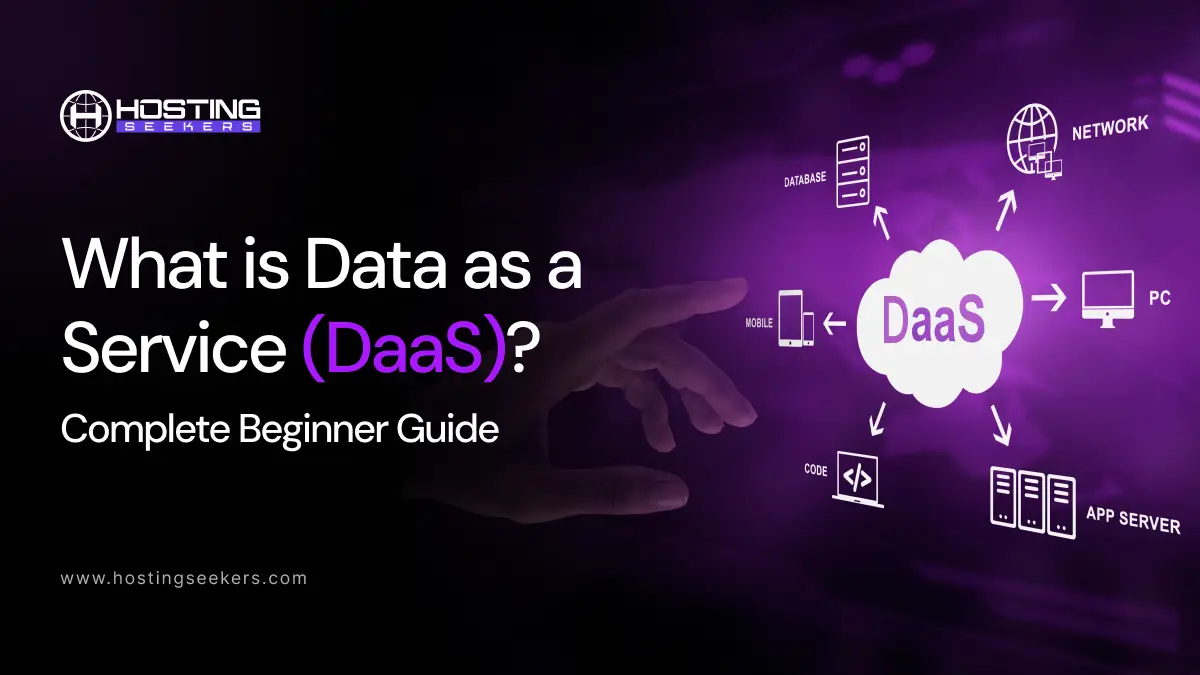
What is Data as a Service (DaaS)? Complete Beginner Guide
IT Updated on : July 15, 2026Key Takeaways
- DaaS delivers data as an on-demand service through the cloud, similar to how SaaS delivers software.
- Organizations use DaaS to reduce the cost and complexity of managing their own data pipelines.
- Core DaaS capabilities include data integration, quality management, governance, and API-based delivery.
- DaaS differs from SaaS (which delivers applications) and DBaaS (which delivers raw database infrastructure).
- Leading DaaS providers include Snowflake, AWS Data Exchange, Google Cloud Data Services, IBM, and others.
- DaaS is suitable for enterprises, mid-sized businesses, and increasingly small businesses with data needs.
- Key challenges include data security, vendor dependency, latency, and compliance management.
Collecting, storing, processing, and delivering the data successfully is quite an operational burden, especially for teams without dedicated data engineering resources. Here comes Data as a Service (DaaS), which addresses this challenge directly by moving data management and delivery into the cloud. It allows businesses to consume data as a utility, where you only need to pay for what you use, can access it whenever you need, and save yourself from heavy infrastructure investment. So, let’s explore what DaaS is, how it works, its key features, benefits, architecture, top providers, and common challenges.
What is Data as a Service and Why It Matters?
Data as a Service (DaaS) is a cloud-enabled data management strategy in which data is collected, processed, and delivered to end users or applications through a network, typically via APIs or cloud platforms and on demand.
Under the DaaS model, a provider manages all underlying data infrastructure: storage, processing, cleansing, integration, and delivery. The consumer accesses structured, ready-to-use data without needing to handle any of those processes themselves.
DaaS sits within the broader “as-a-service” family of cloud models, alongside:
- SaaS – Software as a Service (delivers applications)
- PaaS – Platform as a Service (delivers development platforms)
- IaaS – Infrastructure as a Service (delivers compute and storage)
- DBaaS – Database as a Service (delivers managed database engines)
The DaaS model is distinct because its core product is the data itself, which is curated, governed, and ready for use.
In simple words, DaaS is the delivery of data on demand via the cloud, managed by a third-party provider, and accessed through APIs or data-sharing platforms.
How Does DaaS Work?
A DaaS platform operates through a multi-stage pipeline that transforms raw data into reliable, consumable outputs.
Step 1 – Data Ingestion
Data is collected from multiple sources: internal databases, external APIs, IoT sensors, SaaS platforms, public datasets, or partner organizations. Ingestion can happen in real time (streaming) or in scheduled batches.
Step 2 – Data Processing and Transformation
Raw data is cleaned, normalized, deduplicated, and transformed into a consistent format. This step ensures data quality before it reaches the consumer.
Step 3 – Data Storage
Processed data is stored in cloud-based data warehouses, data lakes, or hybrid storage environments optimized for fast retrieval and scalability.
Step 4 – Data Governance and Security
Access controls, usage policies, and audit trails are applied. This includes role-based permissions, encryption, and compliance with regulations such as GDPR or CCPA.
Step 5 – Data Delivery
Consumers access data through APIs, SQL queries, data-sharing platforms, or embedded analytics tools. Delivery can be real-time or scheduled depending on the use case.
Step 6 – Monitoring and Management
The provider continuously monitors pipeline health, data freshness, and usage metrics, often surfacing these through dashboards or alerting systems.
How to build a successful DaaS
Building a DaaS offering, whether as an internal service or a commercial product, requires careful planning across technical, operational, and governance dimensions.
1. Define your data product clearly
Identify what data you are offering, who the consumers are, and what decisions or workflows the data will support. A well-defined data product has a clear schema, refresh cadence, and quality standard.
2. Build a reliable ingestion pipeline
Use tools that support both batch and streaming ingestion. Ensure connectors exist for all relevant data sources. Prioritize reliability and fault tolerance from the start.
3. Invest in data quality
A DaaS offering is only as valuable as the accuracy of its data. Implement automated validation rules, anomaly detection, and data lineage tracking to maintain trust.
4. Design for API-first delivery
Expose data through well-documented, versioned APIs. RESTful and GraphQL APIs are common choices. Ensure endpoints are secure and rate-limited appropriately.
5. Establish governance from day one
Define data ownership, access tiers, retention policies, and audit logging before onboarding users. Retroactively applying governance to an ungoverned system is costly.
6. Plan for scalability
Design storage and compute layers to scale horizontally. Cloud-native services (such as managed data warehouses) handle much of this automatically if architected correctly.
7. Monitor and iterate
Track data freshness, query latency, pipeline failures, and consumer usage patterns. Use this data to improve reliability and prioritize new data products.
Key Features of DaaS
| Feature | Description |
|---|---|
| API-based data access | Data is accessible via REST, GraphQL, or JDBC/ODBC interfaces |
| Multi-source integration | Combines data from internal systems, external providers, and public sources |
| Data quality management | Automated cleansing, validation, and enrichment processes |
| Scalable storage | Cloud-native storage that scales with demand |
| Data governance | Role-based access control, data lineage, and compliance enforcement |
| Real-time and batch delivery | Supports both streaming and scheduled data delivery |
| Data catalog | Searchable inventory of available datasets with metadata |
| Usage monitoring | Dashboards showing consumption, costs, and pipeline health |
| Security and encryption | Data encrypted at rest and in transit with audit logging |
| Self-service access | Users can discover and consume data without engineering assistance |
Benefits of Data as a Service
- Reduced Infrastructure Costs
- Faster Time to Insight
- Improved Data Quality
- Scalability
- Broader Data Access
- Stronger Governance and Compliance
- Democratization of Data
Top 10 Data as a Service Companies
The following are established DaaS providers and platforms widely recognized in the industry.
| Provider | Primary DaaS Type | Best For | Free Tier |
|---|---|---|---|
| Snowflake | Data Cloud / Sharing | Enterprise analytics & data monetization | Yes |
| Google BigQuery | Serverless data warehouse | Cloud-native analytics & ML | Yes |
| AWS Data Exchange | Third-party data marketplace | External data subscriptions on AWS | No |
| Microsoft Azure Synapse | Integrated analytics | Microsoft-stack enterprises | Yes |
| Salesforce Data Cloud | Customer data platform | CRM-centric unified customer data | Yes |
| IBM Cloud Pak for Data | Governed enterprise data | Regulated industries, hybrid cloud | Yes |
| Informatica IDMC | Data integration & governance | Enterprise data quality & governance | Yes |
| Oracle Data Cloud | Audience & commercial data | B2B marketing & advertising data | No |
| Dun & Bradstreet | B2B commercial data | Risk, finance & supply chain data | No |
| Databricks | Data lakehouse platform | Data science & ML pipelines | Yes |
| Domo | BI & embedded data delivery | Self-service analytics for SMBs | Yes |
Note: The DaaS market is broad and evolving. Many industry-specific providers also operate in this space, including data brokers, financial data providers, geospatial data companies, and healthcare data firms.
Why are Businesses Shifting to DaaS Models?
Several structural forces are driving the adoption of DaaS across industries :
- Growing data complexity: Modern organizations deal with data from dozens of sources CRM systems, marketing platforms, IoT devices, transactional databases, and more. Managing these integrations internally is increasingly expensive.
- Skills shortages: Data engineering talent is in high demand and short supply. DaaS reduces the burden on internal teams by offloading pipeline management to specialized providers.
- Cost pressure on IT infrastructure: Cloud economics favor operational expenditure (OpEx) over capital expenditure (CapEx). DaaS converts what was a fixed infrastructure cost into a variable, usage-based cost.
- Demand for real-time data: Business users increasingly expect real-time or near-real-time data. DaaS providers have built streaming infrastructure that most organizations cannot cost-effectively replicate internally.
- Regulatory complexity: Privacy regulations (GDPR, CCPA, HIPAA) require documented data lineage, consent management, and access controls. DaaS platforms increasingly offer built-in compliance features that are difficult to build from scratch.
- Monetization opportunities: Organizations with valuable proprietary data are increasingly packaging it as a DaaS product creating new revenue streams from data assets that previously had no direct commercial application.
Who Should Use DaaS?
DaaS is broadly applicable, but it is particularly well-suited to the following types of organizations and users.
- Enterprises with complex data ecosystems: Large organizations managing hundreds of data sources across business units benefit from the centralized data management, governance, and delivery that DaaS platforms provide.
- Mid-sized businesses without large data teams: Companies that need reliable data but cannot justify a full-scale data engineering team can use DaaS to access the data infrastructure capabilities of much larger organizations.
- Startups that need to move fast: Early-stage companies can avoid building custom data pipelines and instead focus engineering resources on their core product.
- Analytics and data science teams: Teams that need clean, ready-to-query data can use DaaS to reduce time spent on data preparation and focus more on analysis and modeling.
- Product teams building data-driven features: Development teams can consume DaaS APIs to embed data directly into applications, dashboards, or customer-facing products.
- Organizations in regulated industries: Healthcare, financial services, and insurance companies can benefit from DaaS platforms that offer built-in compliance tooling.
Small businesses can also use DaaS, particularly through marketplace-based providers that offer affordable, pay-per-use access to enriched datasets like customer demographic data, market pricing, or local business information.
Future of Data as a Service
Several trends are shaping the next wave of DaaS development.
- AI and machine learning integration: DaaS platforms are increasingly embedding AI-powered features, automated data quality checks, anomaly detection, natural language querying, and predictive metadata tagging directly into their pipelines.
- Real-time data mesh architectures: The data mesh paradigm, which distributes data ownership across business domains, is influencing DaaS architecture. Platforms are building tools that support decentralized data products governed by common standards.
- Synthetic data as a service: To address privacy constraints, providers are beginning to offer synthetic datasets, statistically representative data generated by AI models that preserve analytical value without exposing personal information.
- Cross-cloud data sharing: Multi-cloud data sharing without physical data movement is becoming a standard capability, reducing duplication costs and improving data governance across cloud providers.
- Embedded data products: Increasingly, DaaS data is being embedded directly into operational applications and not just used in analytics, enabling data-driven workflows at the point of decision.
- Tighter regulatory alignment: DaaS providers are building deeper compliance frameworks to support evolving global data regulations, including the EU AI Act and emerging data sovereignty requirements.
DaaS Architecture
DaaS architecture defines how data flows from source systems to end consumers. A well-designed DaaS architecture is modular, scalable, and governed at every layer.
Core Architectural Layers
- Data Sources Layer: Raw data originates from internal systems (ERP, CRM, databases), external APIs, IoT devices, streaming platforms, and third-party providers.
- Ingestion Layer: Data is pulled or pushed into the platform via ETL (Extract, Transform, Load) or ELT (Extract, Load, Transform) tools. Batch and streaming ingestion may coexist in the same architecture.
- Storage Layer: Processed data is stored in cloud data warehouses (for structured data), data lakes (for raw and semi-structured data), or lakehouses (a hybrid combining warehouse structure with lake flexibility).
- Processing and Transformation Layer: Data is enriched, joined, validated, and restructured using workflow orchestration tools. This layer enforces business rules and data quality standards.
- Governance Layer: Data catalogs, lineage tracking, access control lists, and policy engines operate at this layer. Governance ensures that data is used appropriately and compliantly throughout its lifecycle.
- Delivery Layer: Consumers access data via APIs (REST, GraphQL), JDBC/ODBC connections, data-sharing protocols, or direct integrations with analytics tools and dashboards.
- Monitoring Layer: Observability tools track pipeline health, data freshness, query performance, and usage patterns. Alerts surface issues before they affect data consumers.
DaaS Architecture Diagram (Simplified)
| Data Sources |
| ↓ |
| Ingestion Layer Batch / Streaming |
| ↓ |
| Storage Layer Data Warehouse / Data Lake / Lakehouse |
| ↓ |
| Processing Layer Transformations / Enrichment / Quality Checks |
| ↓ |
| Governance Layer Catalog / Access Control / Lineage |
| ↓ |
| Delivery Layer APIs / SQL / Dashboards / Data Shares |
| ↓ |
| End Consumers Analysts / Applications / Data Scientists |
What are the Challenges of Data as a Service?
While DaaS offers significant advantages, organizations should be aware of the following challenges before adopting it:
- Data Security & Privacy: Sharing data with third-party platforms introduces risks. It’s important to verify certifications like SOC 2 Type II and ISO 27001 and understand how data is stored and accessed.
- Vendor Lock-In: Relying on a single provider can make switching difficult due to differences in data formats, APIs, and pricing models.
- Data Latency: Not all platforms provide real-time data. Businesses must evaluate latency based on their use cases.
- Data Ownership & Licensing: A clear understanding of data usage rights and retention policies is essential when using third-party datasets.
- Integration Complexity: Connecting DaaS with legacy or on-premise systems may require significant technical effort.
- Cost Management: Usage-based pricing can become expensive without proper governance and monitoring.
- Data Quality Responsibility: Even with managed pipelines, organizations must validate data accuracy, freshness, and relevance.
- Compliance Requirements: Regulated industries must ensure providers meet strict data residency and compliance standards.
DaaS vs SaaS: What’s the Difference?
DaaS delivers on-demand data for analytics and decision-making, while SaaS provides ready-to-use software applications over the internet.
| Feature | DaaS (Data as a Service) | SaaS (Software as a Service) |
|---|---|---|
| Definition | Delivers data on demand via cloud platforms | Delivers ready-to-use software over the web |
| Primary Focus | Data access, sharing, and analytics | Application usage and functionality |
| Users | Data teams, analysts, developers | End users, businesses, teams |
| Examples | Snowflake, BigQuery, Databricks | Google Workspace, Salesforce, Slack |
| Customization | High (data queries, pipelines, integrations) | Limited to app features and settings |
| Pricing Model | Usage-based (data queries, storage, compute) | Subscription-based (monthly/yearly plans) |
| Integration | Requires integration with data systems | Minimal setup, ready to use |
| Data Ownership | The user often controls/uses external datasets | Data managed within the application |
| Use Cases | Analytics, ML, data sharing, BI | CRM, email, and collaboration |
Conclusion
Data as a Service is a growing model for delivering reliable, governed, and scalable data to organizations of all sizes. By abstracting the complexity of data infrastructure, DaaS enables teams to focus on deriving value from data rather than managing the pipelines that produce it. For organizations exploring DaaS, the key steps are to define specific data needs, evaluate providers against security and compliance requirements, and pilot with a focused use case before committing a full-scale deployment.
As cloud infrastructure, AI tooling, and data sharing standards continue to mature, DaaS will become an increasingly foundational component of enterprise data strategy.
Frequently Asked Questions
Q1. What is the meaning of DaaS as a service?
Ans. DaaS stands for Data as a Service. It is a cloud-based model in which data is managed, processed, and delivered to users or applications on demand, typically through APIs or managed data platforms by a third-party provider. Users access clean, structured data without needing to build or operate the underlying data infrastructure themselves.
Q2. Is DaaS secure?
Ans. DaaS security depends on the provider and the implementation. Reputable DaaS providers implement encryption at rest and in transit, role-based access controls, audit logging, and compliance certifications such as SOC 2 Type II and ISO 27001. However, organizations remain responsible for evaluating provider security practices, managing user permissions on their end, and ensuring that data sharing agreements comply with applicable regulations such as GDPR or HIPAA.
Q3. How is DaaS different from SaaS?
Ans. SaaS (Software as a Service) delivers software applications over the internet, tools like CRM systems, email platforms, or productivity suites. DaaS (Data as a Service) delivers data itself, not applications. A SaaS product might use DaaS in the background to power features, but the end product the user interacts with is an application, not raw data. In short: SaaS delivers functionality; DaaS delivers the data that powers functionality.
Q4. Can small businesses use DaaS?
Ans. Yes. DaaS is increasingly accessible to small businesses through cloud marketplaces and self-service platforms that offer pay-per-use pricing. Small businesses can access third-party datasets, such as customer demographic data, local market pricing, or business directories, without needing to invest in data infrastructure. Select a provider that offers appropriate pricing and support for smaller users.
Q5. What is the difference between DaaS and DBaaS?
Ans. DaaS (Data as a Service) delivers curated, structured, and often enriched data to consumers. The provider manages the full data lifecycle: ingestion, processing, governance, and delivery, and the consumer accesses ready-to-use data.
DBaaS (Database as a Service) delivers a managed database engine. The provider manages the infrastructure (servers, backups, replication, patching), but the consumer is responsible for designing the schema, loading data, writing queries, and managing data quality.
Meaning, DaaS delivers data products; DBaaS delivers the managed infrastructure to store and query your own data.
| Dimension | DaaS (Data as a Service) | DBaaS (Database as a Service) |
|---|---|---|
| What is delivered | Curated, ready-to-use data | Managed database engine |
| Who manages the data | The provider | The consumer |
| Who designs the schema | The provider | The consumer |
| Primary user | Data analysts, app developers | Database administrators, engineers |
| Examples | AWS Data Exchange, Snowflake Marketplace | Amazon RDS, Google Cloud SQL, Azure SQL Database |

manvinder Singh
https://www.hostingseekers.com
Manvinder Singh is the Founder and CEO of HostingSeekers, an award-winning go-to-directory for all things hosting. Our team conducts extensive research to filter the top solution providers, enabling visitors to effortlessly pick the one that perfectly suits their needs. We are one of the fastest growing web directories, with 500+ global companies currently listed on our platform.